11-course lute music
Actually all my lute videos are concentrated in my
Archlute page
since autumn 2015!
Updated 31.8.2015.
/
© Arto Wikla
12.1.2010
After quite a few years of playing different types of lutes, archlutes
and therbos
in the "old tuning", in December 2009 I started to play also the 11 course
baroque lute in d-minor tuning.
My new(old) instrument is made by Lars Jönsson 1993.
Here are my first (visual) impressions.
This really is a learning project to me -- the d-minor lute is a very
different animal compared to my "vieil accord" experience.
But it is also very interesting to be a beginner again... ;-)
And after having used my ordinary digital cameras for videoclips - with their
bad/awfull sound recording qualities -
now I luckily at last have a little better recorder (unluckily only soundwise),
the Zoom O3.
But it also hears much more... You know, what I mean...
- Very first tests:
[The Zoom Q3 seems to need much more light than my "normal" digital cameras...
And my playing technique produces lots of noise from the gut strings...]
- Anonymous: Chaconne (Kalmar f.9r)
The piece comes from ms. Kalmar KLM 21.068. fol. 9r.
To me this is a triple test: first time 11 c. baroque lute,
first time gut strings, first time Zoom Q3 recorder.
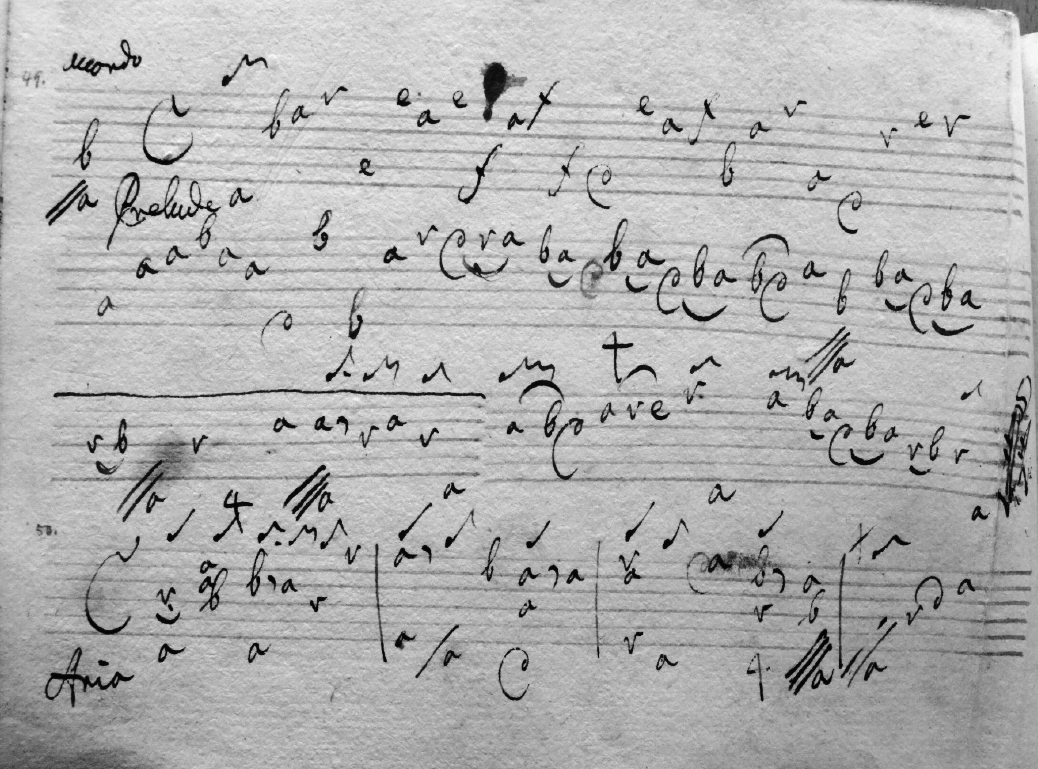
The original tabulature.
Video in YouTube,
video in Vimeo (16.12.2009)
- Anonymous: Gigue (Wien p.3)
The piece comes from Ms.Mus.17706, p.3, of Oesterreichische
Nationalbibliothek. I am still testing to me new combination:
11 c. baroque lute, gut strings, Zoom Q3 recorder.
Video in YouTube,
video in Vimeo (21.12.2009)
- Second set of tests:
[More light and a little different touch to try to reduce the noise...]
- Anders von Düben: Marche de Narva (Kalmar68 f.10v)
This anonymous lute arrangement of of a marche by Anders von Düben
comes from ms. Kalmar KLM 21.068. fol. 10v.The original name by von
Düben is "Marche pour les Suedois - Narvamarschen" and it is part of
the "Comedie-balett: Narvabaletten", first performed 6 february 1701.
There is a clip of the
original
version in the y-tube, too:
The piece was composed to celebrate the victory of the Swedish king
Charles XII (Karl XII) of his opponent Peter the Great of Russia in
Narva, January 1700.
...still testing...
The original tabulature.
Video in YouTube,
video in Vimeo (28.12.2009)
- J.J. Sautscheck (= R. Turovsky): Passacaglia sopra Piango, gemo, sospiro
(SWV p4am).
Video in YouTube,
video in Vimeo
... still testing... (4.1.2010)
- Anonymous: Les Tricotins - Gavotte
This is a medley of two versions of the same(?) piece: Les Tricotins
(ms. Milleran, f.29v), and Gavotte (ms. Kalmar 21068, f.2r).
Video in YouTube,
video in Vimeo.
Still testing... (11.1.2010)
- Learning continues...
- Denis Gaultier: La Tenebreuse - Narcisse.
This version comes from ms. Barbe. In "Rhetorique des Dieux" this
piece is called "Narcisse". In this case perhaps also the "tenebreuse" picture
quality is acceptable...;-)
Video in YouTube,
video in Vimeo.
(17.1.2010)
- Robert de Visee: La Montfermeil, Rondeau.
"La Montfermeil, Rondeau transposee du theorbe"
(ms. Saizenay, p. 64). This piece was originally composed to theorbo,
but already in those days also arranged to the baroque lute.
Video in YouTube,
video in Vimeo
(23.1.2010).
[I have recorded also the theorbo version, see my page
French theorbo music or directly in
tube or
vime.]
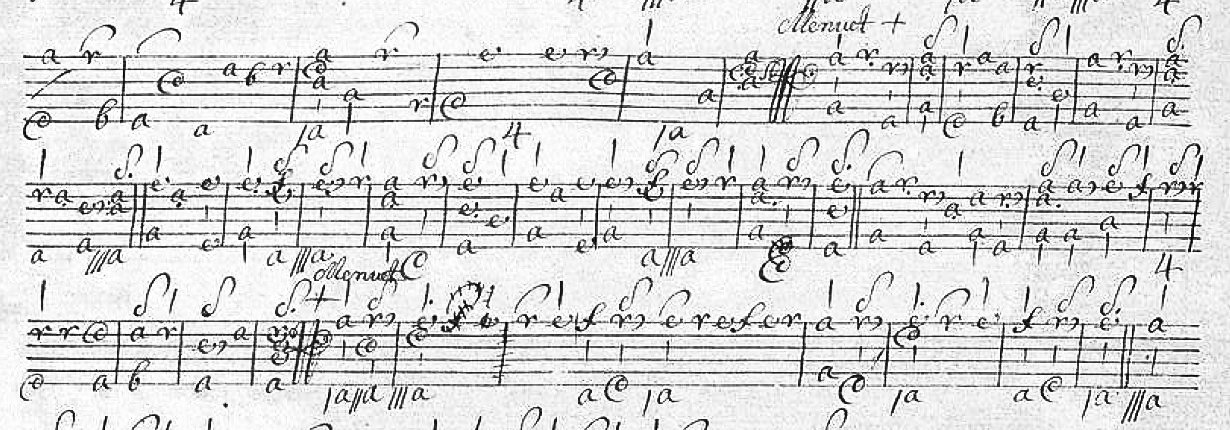
- Lully/Mouton: Menuet de L'Opera de Proserpine.
"Menuet de L'Opera de Proserpine, transposee par Mr Mouton"
(ms. Milleran f. 27r).
Video in YouTube,
video in Vimeo.
(23.1.2010)
- Anonymous pieces from ms. Berlin 40068
- Allemande (f. 19r).
Video in YouTube,
video in Vimeo.
(1.2.2010)
- Courrente (f. 18v).
Video in YouTube,
video in Vimeo.
(1.2.2010)
- Sarabande (f. 19v).
Video in YouTube,
video in Vimeo.
(1.2.2010)
- Europe, rebellious movements, peace, joy
- Charpentier: Prelude of Te Deum.
This is my own arrangement of Marc-Antoine Charpentier's very famous
piece, which is used for example as the theme music for EBU (European Broadcasting
Union). So it is kind of "Euro-pop" known practically to every European...
Here is my
arrangement for 11-course baroque lute (pdf).
Video in YouTube,
video in Vimeo.
I could not decide which one of the two played versions I should send to public. So
I glued them together...;-)
(8.2.2010)
- Mouton or Pinel: La Gavotte Royalle, ou Frondeuse.
This piece is attributed both to Charles Mouton and Germain Pinel. I play here
two versions, first ms. Milleran, f.28r., and then ms. Kalmar 21068,
f.3r. Neither of the versions name the composer. Kalmar just gives
title "Gavotte". Milleran tells more "La Gavote Royalle, ou Frondeuse".
The name of the piece "Royalle ou Frondeuse" must have had a special message
to the French at the end of 17th century, because there recently had been two
"frondes", rebellious movements, against Cardinal Mazarin (actually in power
instead of still very young Louis XIV). The first "fronde" was "Fronde
Parlementaire" (1648-1649) and the second "Fronde des nobles" (1650-1653).
Video in YouTube,
video in Vimeo.
(8.2.2010)
- E. Gaultier or Mesangeau: Sarabande (ms. SaizenayII p.94).
Ms. SaizenayII gives composer name "vieux Gaultier" (=Ennemond
Gaultier = Gaultier de Lyon), ms. Vm7_6211 gives "gautier".
But ms. Barbe attributes the piece to Rene Mesangeau. Well, anyhow
Rene was Ennemond's lute teacher...
Video in YouTube,
video in Vimeo.
(15.2.2010)
- Ennemond ("vieux") Gaultier: Chaconne (ms. Saizenay p.20).
Video in YouTube,
video in Vimeo.
(15.2.2010)
- A French drama:
1: "Open the door, please!"
2: "Ah, I feel inclined to surrender..."
3: ...
4: ... ;-)
- Ouvrez-moy la porte, petite Nannon (ms. Saizanay, p.16).
This is an anonymous 17th century lute arrangement of a Frech folk song(?).
I play three a little different versions, because petite Nannon needs
lots of talking to open the door...;-)
Video in YouTube,
video in Vimeo.
(22.2.2010)
- Gaultier(?): Sarabande La Mignone
(Saizenay p.1).
This piece is in ms. Saizenay p.1 and Saizenay II p.3. I play here the
first version. The second version gives the name "La Mignone
and there is also a poem:
Ah! que je sens de penchant à me rendre /
Si mon Berger savait par où me prendre /
Hélas! comment pourrais-je me défendre /
Contre un amant si fidèle et si tendre.
In English this is something like:
Ah, I feel inclined to surrender /
If my Shepherd knew where to take me /
Alas! how could I defend myself /
Against a lover so true and so tender.
Video in YouTube,
video in Vimeo.
(22.2.2010)
- Ennemond ("vieux") Gaultier: Sarabande (Livre p.40).
This piece was printed in "Livre de tablature ... de Mr. Gaultier
Sr. de Neve et de Mr. Gaultier son cousin" (c. 1672), pages 40-41.
Video in YouTube,
video in Vimeo.
(22.2.2010)
- Ennemond ("vieux") Gaultier: Canaries (Livre p.18).
This piece was printed in "Livre de tablature ... de Mr. Gaultier
Sr. de Neve et de Mr. Gaultier son cousin" (c. 1672), pages 18-19.
Video in YouTube,
video in Vimeo.
(25.2.2010)
- Mouton
- Charles Mouton: My Mistress is Prettie - La Mantovana.
This piece comes from ms. Balcarres, p. 85. The title in the ms. is
"My Mistress is Prettie, by monsieur Mouton". The melody is
also known by names "La Mantovana", "Ballo di Mantova",
"Branle de Mantove", "Fuggi, fuggi", etc., etc...
Video in YouTube,
video in Vimeo.
(1.3.2010)
- Charles Mouton: La Richelieu, Sarabande.
This piece comes from ms. Praha Kk 80, pp.102-103.
Well, everybody knows, who Richelieu was... :-)
Video in YouTube,
video in Vimeo.
(7.3.2010)
- Charles Mouton: La belle Astrée, Chaconne.
This piece comes from ms. Praha Kk 80, p.106.
In Greek mythology Astrea was a daughter of Zeus and Themis or of Eos
and Astraeus. She and her mother were both personifications of justice,
though Astrea was also associated with innocence and purity.
During the European Renaissance, Astrea became associated with the general
spirit of renewal of culture occurring at that time.
Video in YouTube,
video in Vimeo.
(8.3.2010)
- Charles Mouton: Prelude.
This unmeasured prelude by Charles Mouton comes from ms. Milleran, f.20.
Unmeasured preludes do not have barlines - as the term says. Often
there are neither any note value indications. So there is lots of
improvisation in this type of pieces!
Video in YouTube,
video in Vimeo.
(14.3.2010)
- Lully/Mouton: Gavotte de L'Opera de Psyche.
"Gavotte de L'Opera de Psychee, transposee par Mr Mouton",
ms. Milleran f. 26v.
Video in YouTube,
video in Vimeo.
(14.3.2010)
- Lully/Mouton: Menuet de L'Opera de Bellerophon.
"Menuet de L'Opera de Bellerophon, transposee par Mr Mouton",
ms. Milleran f. 24v.
Video in YouTube,
video in Vimeo.
(15.3.2010)
- Gaultiers, Courantes with names, ms. Barbe, ...
- Denis Gaultier: Courante "Canon".
This version of the very popular "Canon de Gautier" comes
from ms. Barbe, p.1.
The composer is probably Denis G.
Video in YouTube,
video in Vimeo.
(22.3.2010)
- Denis Gaultier: Courante "La Royale".
This "La Royale Courante de Gautier" comes
from ms. Barbe, p.7.
The composer is probably Denis G.
Video in YouTube,
video in Vimeo.
(29.3.2010)
- Ennemond Gaultier: Courante "L'Immortelle" (ms. Barbe).
This "L'Immortelle du V. Gautier" comes
from ms. Barbe, p.2.
Video in YouTube,
video in Vimeo.
(3.4.2010)
- Denis Gaultier: Courante "La Lyonnaise".
This "La Lionoise de Gautier" comes
from ms. Barbe, p.6.
The composer is probably Denis Gaultier.
Perhaps I am allowed to dedicate
this piece to my end of 1980's French-Finnish girlfriend, who was
born in Lyon? ;-)
Video in YouTube,
video in Vimeo.
(5.4.2010)
- "Mr. Beck" in Scottish ms. Balcarres (17th century)
- "Mr. Beck"(?): The prince's air.
Balcarres p. 11:
"The prince's air, the 9th lowed halfe a note, mr. Beck's way".
Video in YouTube,
video in Vimeo.
(12.4.2010)
- "Mr. Beck"(?): Dolas air.
Balcarres p. 11:
"Dolas air, with the 9th lowed halfe a note, mr. Beck's way".
Video in YouTube,
video in Vimeo.
(12.4.2010)
- Lully/"Mr. Beck"(?): Belle hereuse (="Sommes nous pas
trop heureux"). Balcarres p. 19:
"Belle hereuse, with the 9th lowed halfe a note, mr. Beck's way".
Actually this is an arrangement of a song by Lully: "Sommes nous pas
trop heureux" (Ballet de l'Impatience, 1661).
You can find the original Lully piece
and my theorbo version by de Visee in my
French theorbo page.
Video in YouTube,
video in Vimeo.
(13.4.2010)
- "Mr. Beck"(?): What if a day, a month, or a year".
Balcarres p. 127:
"What if a day, a month, or a year, with the 9th lowed half a note, Jean
More's way, by mr. Beck". This song was arranged by many composers
around 1600 - Dowland included. This arrangement by "Mr. Beck"(?) is
special, because it is nearly 100 years later.
Video in YouTube,
video in Vimeo.
(17.4.2010)
- "Mr. Beck"(?): The canaries, the new way.
Balcarres p. 121:
"The canaries, the new way, with the 9th string lowed half a note, in
Mr. McLaughlan's fashion, by mr. Beck".
Video in YouTube,
(video in Vimeo),
video in Vimeo
2nd try, the 1st doesn't seem to work well).
(19.4.2010)
- "Mr. Beck"(?): Cause give the bride her supper.
Balcarres p. 108 (109?):
"Cause give the bride her supper, the old way, in Mr. McLaughland's
fashion, by mr. Beck".
Video in YouTube,
video in Vimeo.
(23.4.2010)
- Pieces by Nicolas Bouvier in "Tabulature de luth de differents
autheurs sur les accords nouveaux" by Pierre Ballard in 1638.
In year 1638 pieces in the "baroque d-minor tuning" were first time
printed - as far as we know now. Two Pierres were involved: P. Ballard
and P. Gaultier. In their books of "accords nouveaux" only
minority of pieces are in this tuning, which soon became the "standard
tuning": f'-d'-a-f-d-A-G-F-E-D-C. (In these two books they use
only 10 courses, so no low C.)
- Pergolesi: Que ne suis je la fougère.
This is my own arrangement of Pergolesi's famous song arrangement.
Here is my
simple
arrangement for 11-course baroque lute (pdf).
Video in YouTube,
video in Vimeo.
(30.4.2010)
- Pieces in d-minor by the famous "Anonymous" in the
ms. Kalmar KLM 21.072, written around(?) year 1700.
- Prelude (f. 4r).
Video in YouTube,
video in Vimeo.
(5.5.2010)
- Allemande (f. 4v-5r).
Video in YouTube,
video in Vimeo.
(10.5.2010)
- Courante (f. 5v).
Video in YouTube,
video in Vimeo.
(11.5.2010)
-
Well, as the number suggests, there must be a problem (;-):
One bar -- bass bar? -- is loose under the top of the 11-courser.
Rattling. So there is an obligatory pause in my playing 11-course lute music...
Searching for remedy...
(18.5.2010) ...
... At last in 21.6.2010 the lute has been fixed!
A new start... ;-)
- Pierre Gaultier: Courante (Roma 1638, p. 97).
This Courante was published in "Les Ouvres de Pierre Gaultier
Orleanois", Roma 1638. In the year 1638 pieces in the "baroque d-minor
tuning" were first time printed - as far as we know now. Two Pierres
were involved: P. Ballard and P. Gaultier. In their books of
"accords nouveaux" only minority of pieces are in this tuning,
which soon became the "standard tuning": f'-d'-a-f-d-A-G-F-E-D-C.
(In these two books they use only 10 courses, so no low C.)
Video in YouTube,
video in Vimeo.
(29.6.2010)
- Pieces in Austrian style
- Anonymous: Cappricce (1722)
This "Cappricce" is to be found in ms. Rostock Mus.Saec. XVII.18.-52.2., f. 86v.
I play the version published by Giesbert in his famous baroque lute
school. Giesbert calls the ms. just "Deutsches Lautenbuch von 1722".
Video in YouTube,
video in Vimeo.
(16.8.2010)
- Anonymous: Preliminaire (Kalmar68 f.4v)
This anonymous Prelude comes from ms. Kalmar KLM 21.068.
Video in YouTube,
video in Vimeo.
(22.8.2010)
- Caro Mio Ben (?).
This Gavotte is in ms. Rostock Mus.Saec. XVII.18.-52.2., f. 26v.
The piece reminds very much the famous "Caro mio ben", which is said to be by
Giordiano (1748-1798). Well, the ms. was written 20 to 30 years
before Giordiano's birth... Version of this piece is found also
several other mss., and a couple name the composer:
Johann Anton Losy von Losinthal, also known as Comte d'Logy.
Video in YouTube,
video in Vimeo.
(12.9.2010)
- Rieck or Losy (?): Rondeau.
This Rondeau - possibly by Rieck or Losy - comes from ms. Kalmar
KLM 21.072, fol. 73v. I could not choose between my two versions,
so here are both of them...;-)
Video in YouTube,
video in Vimeo.
(14.9.2010)
- Francois Dufault, ... Dufaut, ...,
Du Faut, ... du Faut, ..., Dufaux, ..., Du Faux, ...
- Francois Dufault: L'angelique (ms. Barbe).
This sarabande L'angelique comes from ms. Barbe, p.65.
Video in YouTube,
video in Vimeo.
(19.9.2010)
/
While I was practising this L'angelique, our Finnish-Lappish dog
Pluto came to listen, and also sang a tiny
lamentatio at the end
of the first take; perhaps because I playd one wrong note that
made one cadence quite modern...;-) In the second take he considered it
better to leave.
Video in
YouTube.
- Francois Dufault: Courante Suedoise.
This courante comes from ms. Rostock Mus. Saec. XVII.18.54, p.123.
Video in YouTube,
video in Vimeo.
(24.9.2010)
- Francois Dufault: La Cavaliere (ms. Barbe).
This courante (?) La Cavaliere comes from ms. Barbe, p.66.
The piece is very much in the so called "style brisee"!
Video in YouTube,
video in Vimeo.
(28.9.2010)
- Francois Dufault: La Mignonne (ms. Barbe).
This courante (?) La Mignonne comes from ms. Barbe, p.64.
This piece is very much in the "style brisee"! of the French early
baroque.
Video in YouTube,
video in Vimeo.
(6.10.2010)
There are a few interesting "mistakes" and corrections of "mistakes"
in the
original tabulature
in the ms. Barbe, and in the
modern edition
by CNRS. I have marked my own "corrections" or perhaps
my own "mistakes"(?) to both versions:
- Second last bar of A section: CNRS has moved the letter "c"
from 5th course to 4th, from e to g in C major chord. I agree.
- Section B, 4th whole bar: there is no comma (,) after the open
first string a, neither in the original or the CNRS. I think there
must be an ornament, because of similiar places before and after.
- The A section has 16 bars, the B section has only 15. The editor
of CNRS has composed an extra bar after the 7th bar of the original.
To me that sounds really bad! Perhaps something else in some other place
would work? Anyhow, the original version with its 15 bars in B section
doesn't sound at all "incomplete" to my ears - the music anyhow is already
quite irregular in itself. So here I definitely keep the original 15 bars.
- B section, bars 10 and 11 (11 and 12 in CNRS):
The tabulature bass line in both versions is
D'-F-C. I think the writer of the ms. has made here
the typical error of placing a letter one course off.
To me it should read D'-C-Bb'. And so I play it.
Much nicer and fits better to the structure of the piece.
- Das Wittgenstein Lauten-Buch
(the Wittgenstein ms. contains music mainly from period 1680-1720):
- Losy: Air and Menuet.
The Air (f.5v) is named to be by "Comte Logy". The Menuet in f.6r
(same opening of the book) has no composer name, but it is made
from the material of the Air. So I would suggest Losy.
Video in YouTube,
video in Vimeo.
(13.10.2010)
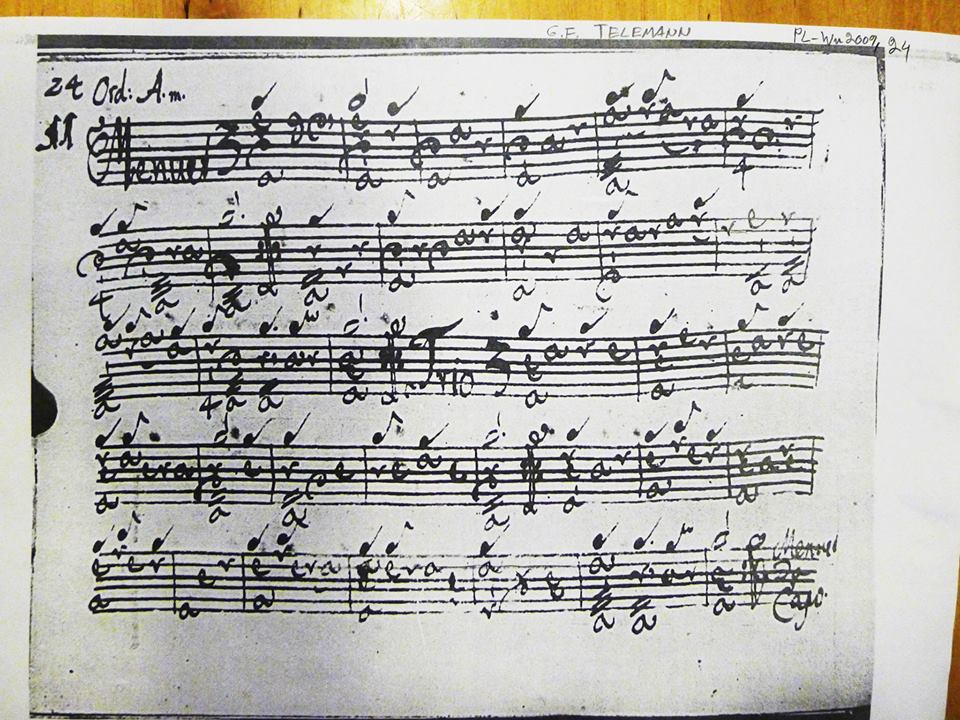
- Telemann: "Kom ach kom mein wehrtes Leben".
This simple anonymous arrangement of Telemann's song (TWV 36:10) comes from
ms. Wittgenstein, f.2r.
Video in YouTube,
video in Vimeo.
(17.10.2010)
- Losy: Menuet.
This Menuet is in fol. 11r.
Video in YouTube,
video in Vimeo.
(22.10.2010)
- Pieces from ms. RM 4142 (olim Ms. Mf. 2010),
Warszawa, Biblioteka Uniwersytecka:
- Aureus Dix: Courante,
p. 106-107.
Video in YouTube,
video in Vimeo.
(25.10.2010)
- Aureus Dix: Sarabande,
p. 107.
Video in YouTube,
video in Vimeo.
(25.10.2010)
- Aureus Dix: Menuet,
p. 109.
Video in YouTube,
video in Vimeo.
(25.10.2010)
- Good composers in ms. Milleran:
- Jean Mercure: Sarabande.
This early type of sarabande comes from ms. Milleran f. 22v.
Video in YouTube,
video in Vimeo.
(21.11.2010)
- Ennemond ("vieux") Gaultier: Passacaille.
This piece comes from
ms. Milleran f. 67v.
Video in YouTube,
video in Vimeo.
(22.11.2010)
- Lully/Mouton: Gavotte de L'Opera d'Isis (ms. Milleran).
This "Gavote de L'Opera d'Isis, transposee par Mr Mouton"
comes from ms. Milleran f. 66v.
Video in YouTube,
video in Vimeo.
(22.11.2010)
- Lully/Mouton: Menuet de L'Opera du Triomphe de l'Amour (ms. Milleran).
This "Menuet de L'Opera du Triomphe de l'Amour, transposee par Mr Mouton"
comes from ms. Milleran f. 87v.
Video in YouTube,
video in Vimeo.
(8.12.2010)
- A couple of arrangements:
- Heinilla harkien kaukalon
(related to "Entre le boeuf et l'ane gris").
The song is originally a French folk song known already at
least in the 17th century.
This is my simple arrangement to baroque lute, and
here is
the lute tabulature (pdf).
Video in YouTube,
video in Vimeo.
(15.12.2010)
- Jean Babtiste Stuck alias "Batistin":
Les Bains de Tomery.
The lute version is my own arrangement:
the lute solo,
the original song.
Video in YouTube,
video in Vimeo
(7.1.2011).
Probably just this opening recitative of the cantata
"Les Bains de Tomery" was a favorite song of J-J. Rousseau, see
Confessions, IV eme livre 1730-1731:
[...]
I arose, shook off the remains of drowsiness, and finding I was hungry,
retook the way to the city, resolving, with inexpressible gayety,
to spend the two pieces of six francs I had yet remaining in a good
breakfast. I found myself so cheerful that I went all the way singing;
I even remember I sang a cantata of Batistin's called the Baths of
Thomery, which I knew by heart. May a blessing light on the good
Batistin and his good cantata, which procured me a better breakfast
than I had expected, and a still better dinner which I did not
expect at all! In the midst of my singing, I heard some one behind me,
and turning round perceived an Antonine, who followed after and seemed
to listen with pleasure to my song. At length accosting me, he asked,
If I understood music. I answered, "A little," but in a manner to have
it understood I knew a great deal, and as he continued questioning
of me, related a part of my story. He asked me, If I had ever
copied music? I replied, "Often," which was true: I had learned most
by copying. "Well," continued he, "come with me, I can employ you
for a few days, during which time you shall want for nothing;
provided you consent not to quit my room." I acquiesced very willingly,
and followed him.
This Antonine was called M. Rotichon; he loved music, understood it,
and sang in some little concerts with his friends; thus far all was
innocent and right, but apparently this taste had become a furor,
part of which he was obliged to conceal. He conducted me into a
chamber, where I found a great quantity of music: he gave me some to
copy, particularly the cantata he had heard me singing, and which he
was shortly to sing himself.
[...]
- Lute music played in Hannover and Hamburg c. 1710.
Young Lord Danby's lutebook has interesting history and
lots of good music. Tim Crawford has made great analysis of the man
and the music, see his article
Lord Danby's Lute Book.
- Passacaille de l'Opera d'Armide (Lully).
This anonymous arrangement of Lully's Passacaille (Armide, Act V scene 2)
comes from ms. Danby, p. 37-38.
The
original tabulature.
Video in YouTube,
video in Vimeo.
(14.1.2011)
- Sarabande de Farinell.
Ms. Danby, p. 75-76. Jean-Baptiste Farinel (1655-c.1720) was maestro di
concerto of the Hannover court orchestra around 1710, while Lord Danby
visited the court.
Video in YouTube,
video in Vimeo.
(16.1.2011)
- Menuet.
Ms. Danby, p. 86.
Video in YouTube,
video in Vimeo.
(17.1.2011)
- Tombeau du Roy d'Orange (Dufault).
This Tombeau (ms. Danby, p. 81) was probably renamed by the lute teacher
of young Lord Danby in Hannover or Hamburg about 1710. The "Roy" is
William III, King of England and Prince of Orange, who died in 1702.
This is the teacher's version of a Saraband by F. Dufault, who died
already c. 1669.
Video in YouTube,
video in Vimeo.
(19.1.2011)
- Gavotte La belle Angloise.
Ms. Danby, p. 12.
Video in YouTube,
video in Vimeo.
(24.1.2011)
- L'Entrée en Angleterre & Gigue de Mylord Danby.
These thematically related two pieces by anonymous composer come
from ms. Danby, p. 15-18.
The
original tabulature.
I suppose the lute teacher in
Hannover or Hamburg composed these pieces to motivate the young
Lord in lute playing? Tim Crawford has written an excellent history
of Lord Danby and his lute book, see his
page.
Video in YouTube,
video in Vimeo.
(28.1.2011)
- Anonymous pieces in A-KR-L78 –
Kremsmünster, Benediktiner-Stift Kremsmünster,
Regenterei oder Musikarchiv: ms. L78:
- Aria (Caro Mio Ben?) (fol. 12r).
The piece reminds very much the famous "Caro mio ben", which is
said to be by Giordiano (1748-1798). Well, this manuscript was written
years before Giordiano's birth...
Versions of this piece are
found also in several other mss. I have recorded also another
version
of this piece.
Video in YouTube,
video in Vimeo.
(5.2.2011)
- Passagaglia (fol. 32v–33r).
Video in YouTube,
video in Vimeo.
(14.2.2011)
- Prelude (fol. 30v).
Video in YouTube,
video in Vimeo.
(17.2.2011)
- Aria (fol.
30v–31r).
Video in YouTube,
video in Vimeo.
(21.2.2011)
- Menuet (fol. 31r).
Video in YouTube,
video in Vimeo.
(23.2.2011)
- Jacques Gallot in ms. Barbe:
Very clever composer – not too many notes,
effective 7th chords here and there, quite modern actually...
- L'altesse Royale de Gallot, sarabande.
Jacques Gallot, ms. Barbe, Res. Vmb. ms. 7, p. 15.
Video in YouTube,
video in Vimeo.
(6.3.2011)
- La Nopce de Gallot, gavotte (Barbe p. 85).
Jacques Gallot. The piece is also known by name
"Les Noces de Village". Ms. Barbe, Res. Vmb. ms. 7, p. 85.
Video in YouTube,
video in Vimeo.
(7.3.2011)
- La belle Magnifique, courante (Barbe p. 14).
Jacques Gallot. Ms. Barbe gives just the name
"Courante de Gallot", but another
source gives also the name "La belle Magnifique".
Video in YouTube,
video in Vimeo.
(14.3.2011)
- Gallot: La Coquette - La Grondeuse (Barbe p. 84).
Courante by Jacques Gallot. Ms. Barbe names this piece
"Coquette de Gallot", but other
sources give the name "La Grondeuse, Courante".
Video in YouTube,
video in Vimeo.
(22.3.2011)
- L'homme a bonne fortune de Gallot.
Courante by Jacques Gallot, ms. Barbe, Res. Vmb. ms. 7, p. 86-87.
Video in YouTube,
video in Vimeo.
(28.3.2011)
- La Grenouillere de Gallot.
Piece by Jacques Gallot, ms. Barbe, Res. Vmb. ms. 7, p. 38.
Video in YouTube,
video in Vimeo.
(4.4.2011)
- La Montespan de Gallot.
Chaconne by Jacques Gallot, ms. Barbe, Res. Vmb. ms. 7, p. 47.
Video in YouTube,
video in Vimeo.
(10.4.2011)
- Jacques Gallot in ms. D-Lem ms. II.6.14:
Very clever composer – not too many notes,
effective 7th chords here and there, quite modern...
- La Comete, Chaconne du V. Gallot.
Chaconne by Jacques Gallot, D-Lem ms. II.6.14, f. 52v-54r
(Leipzig, Städtische Bibliotheken, Musikbibliothek).
The piece is really very modern to be composed in the 17th century.
This is why you can find the original tabulature and also modern notation
of the piece here:
original tabulature and
modern notation..
This is my first try of this great piece. More to come, when I learn more?
Perhaps the piece is about the C/1680 V1, also called the Great Comet
of 1680, Kirch's Comet, and Newton's Comet? See the
Wikipedia article.

- First version in 25.4.2011:
YouTube,
Vimeo.
- ... more versions to come, when I learn more (?) ...
- L'espagnolette, Passacaille du V. Gallot.
Passacaille by Jacques Gallot, D-Lem ms. II.6.14, f. 7v-8r
(Leipzig, Städtische Bibliotheken, Musikbibliothek).
Video in
YouTube,
video in
Vimeo
(2.5.2011)
- La Toscanne courante de Gallot V.
Courante by Jacques Gallot, D-Lem ms. II.6.14, f. 17v-18r
(Leipzig, Städtische Bibliotheken, Musikbibliothek).
Video in
YouTube,
video in
Vimeo
(23.5.2011)
- La Sultanne courante du V. Gallot.
Courante by Jacques Gallot, D-Lem ms. II.6.14, f. 6v-7r
(Leipzig, Städtische Bibliotheken, Musikbibliothek).
Video in
YouTube,
video in
Vimeo
(30.5.2011)
- Time for an inventory:
"Jollaksen luuttukirja"
(The Lute Book of Jollas) is kind of inventory of my efforts to learn
11-course baroque lute, starting at the end of 2009. I have also played
these pieces to the Youtube, as you must know, when you are
in this page... The quality of my efforts has been very variable.
Anyhow my aim was not to play very poslished, but mainly I have tried to
explore the repertoire.
In case you are interested in hearing some kind of performances
of the pieces in the book, you may find links in this page, and
also in my
YouTube Channel.
(8.7.2011)
- Courante la bourgeoise de Gallot le Vieux.
Courante by Jacques Gallot, D-Lem ms. II.6.14, f. 58v-59r.
(Leipzig, Städtische Bibliotheken, Musikbibliothek).
Video in
YouTube,
video in
Vimeo
(12.7.2011)
- Pieces in A-KR-L77 – Kremsmünster, Benediktiner-Stift
Kremsmünster, Regenterei oder Musikarchiv: ms. L77:
- Lully/Gallot: C'est l'amour qui nous menace.
This "Aria" by Gallot "le jeune" comes from ms. A-KR L77, f.4v
(Benediktiner-Stift Kremsmunster, Regenterei oder Musikarchiv).
It is an instrumental arrangement of Lully's aria
"C'est l'amour qui nous menace", in opera (tragedie en musique)
"Roland".
Video in
YouTube,
video in
Vimeo
(20.8.2011)
- Menuet and Treza.
These anonymous pieces, Menuet and Treza, come from ms. A-KR L77, f.4v-5r
(Benediktiner-Stift Kremsmunster, Regenterei oder Musikarchiv).
These pieces are on the same opening of the ms. with an "Aria"
by Gallot "le jeune": transcription of Lully's "C'est l'amour qui
nous menace". So there is a tiny possibility that these pieces are
also by Gallot "le jeune".
Video in
YouTube,
video in
Vimeo
(23.8.2011)
- Sarabanda.
This anonymous little Sarabanda comes from ms. A-KR L77, f.5v
(Benediktiner-Stift Kremsmunster, Regenterei oder Musikarchiv).
Video in
YouTube,
video in
Vimeo
(26.8.2011)
- Guigue.
This anonymous Gigue comes from ms. A-KR L77, f.6v-7r
(Benediktiner-Stift Kremsmunster, Regenterei oder Musikarchiv).
Video in
YouTube,
video in
Vimeo
(29.8.2011)
- Praeludium.
This anonymous Prelude comes from ms. A-KR L77, f.7r
(Benediktiner-Stift Kremsmunster, Regenterei oder Musikarchiv).
I play it really freely, but shouldn't you do just that with preludes.
Video in
YouTube,
video in
Vimeo
(29.8.2011)
- Suite "C'est l'amour qui nous menace" (Kremsmunster L77).
This "suite", Praeludium-Aria-Menuet-Treza-Sarabanda-Guigue,
is combined of the previous single videos of pieces in
ms. A-KR L77, f.4v-7r (Benediktiner-Stift Kremsmunster, Regenterei
oder Musikarchiv). These pieces seem to form a nice "suite", too.
I even imagine hearing some thematic connection between the parts...
In these pieces the tuning a'=407Hz sounds beautiful to me.
Recorded in August 20 to 29, 2011.
The music, pdf-file.
Video in
YouTube,
video in
Vimeo
(29.8.2011)
- More lute music played in Hannover and Hamburg c. 1710.
Young Lord Danby's lutebook has interesting history and
lots of good music. Tim Crawford has made great analysis of the man
and the music, see his article
Lord Danby's Lute Book.
(My Lord Danby's Lute Book, Library: Rochester, NY,
Eastman School of Music, University of Rochester, Sibley Music Library).
- Sarabande plaignante et Double.
This anonymous Sarabande and its Double come from
ms. Danby, p. 29-30.
Video in
YouTube,
video in
Vimeo
(6.9.2011)
- Courante.
This anonymous Courante comes from ms. Danby, p. 73-74.
Video in
YouTube,
video in
Vimeo
(11.9.2011)
- Ouverture.
This anonymous Ouverture comes from ms. Danby, p. 71-72.
Video in
YouTube,
video in
Vimeo
(13.9.2011)
- La belle Taille. Pour la maitresse de Mons.r Schutz.
This very strange instrumental arrangement of a song(?)
"La belle Taille" comes from ms. Danby, p. 51-52.
Could the composer of the model of this arr. be Heinrich Schutz?
Probably not.
Video in
YouTube,
video in
Vimeo
(14.9.2011)
- Suite "Plaignante ou La Belle Taille" (ms. Danby).
This "suite", Ouverture, Courante, Sarabande plaignante et Double,
La Belle Taille,
is combined of the previous single videos of pieces in
ms. Danby. Instead of "suite" this is perhaps just "pieces in g minor".
Recorded in September 6 to 14, 2011.
The music, pdf-file.
Video in
YouTube,
video in
Vimeo
(14.9.2011)
- Caquet des femmes, Sarabande Merville.
This Sarabande with quite a non-PC title, composed by Merville,
comes from ms. Barbe (F-PnVmb-7, Paris, Bibliothèque Nationale,
Département de la musique: Res.Vmb.ms.7), p.17.
Video in
YouTube,
video in
Vimeo
(26.9.2011)
- Pieces by Germain(?) Pinel
in
ms. F-PnVmb-7 "Barbe"
(Paris, Bibliothèque Nationale, Département de la musique)
and
ms. D-SWl_641 "Schwerin"
(Schwerin, Landesbibliothek Mecklenburg-Vorpommern, Musikaliensammlung).
- Allemande.
Ms. Barbe, p.9.
Video in
YouTube,
video in
Vimeo
(29.9.2011)
- Courante.
Ms. Barbe, p.10.
Video in
YouTube,
video in
Vimeo
(6.10.2011)
- Sarabande.
Ms. Barbe, p.11.
Video in
YouTube,
video in
Vimeo
(7.10.2011)
- Brandle des Frondeurs. Ms. Schwerin, p.4.
The name of this Branle must have had a special message to the French at
the end of 17th century, because there recently had been two "frondes",
rebellious movements, against Cardinal Mazarin (actually in power instead
of still very young Louis XIV). The first "fronde" was "Fronde
Parlementaire" (1648-1649) and the second "Fronde des nobles" (1650-1653).
Video in
YouTube,
video in
Vimeo
(13.10.2011)
- Entrée de Luth. Schwerin, p.3.
Unmeasured entrées and preludes do not have barlines - as the term
says. Often there are neither many/any note value indications.
So there is lots of room to improvising!
Video in
YouTube,
video in
Vimeo
(13.10.2011)
- Suite "Frondeurs" in d-minor (mss. Schwerin and Barbe).
This "suite" —
Entrée de Luth,
Allemande,
Courante,
Sarabande,
Brandle des Frondeurs —
is combined of the previous single videos of pieces in mss.
Schwerin and Barbe. Instead of real "suite" this perhaps should
just be called "pieces in d minor".
Recorded in September 29 to October 13, 2011.
The music, pdf-file.
Video in
YouTube,
video in
Vimeo
(13.10.2011)
- Testing new lute! Today, 28.10.2011, I got a new
11-course baroqu lute, model J.C. Hoffmann. The lute is made by
Lauri Niskanen, and it was finished just the day before yesterday.
- XLII Air (ms. Wittgenstein fol. 16v).
The lute is really very new! And I have had
it only a few hours...
Video in
YouTube,
video in
Vimeo
(28.10.2011)
- XLIII Menuet and XLIV Sarabande (ms. Wittgenstein fol. 16v-17r).
Video in
YouTube,
video in
Vimeo
(30.10.2011)
- XXXII Menuet (ms. Wittgenstein fol. 13r).
Video in
YouTube,
video in
Vimeo
(7.11.2011)
- LVI Harlekinada (ms. Wittgenstein fol. 21v-22r).
Video in
YouTube,
video in
Vimeo
(8.11.2011)
- XXX Menuet (ms. Wittgenstein fol. 12v).
Video in
YouTube,
video in
Vimeo
(11.11.11)
- XXXIX Tanz (ms. Wittgenstein fol. 15v).
For some reason or another this Tanz was quite difficult
to me. I hope it sounds easy, though...;-)
Video in
YouTube,
video in
Vimeo
(21.11.11)
- Pieces in b-minor from ms. Kremsmunster L85
(Benediktiner-Stift Kremsmunster, Regenterei oder Musikarchiv):
- 80 Prelude, fol. 52v-53r.
Video in
YouTube,
video in
Vimeo
(26.11.2011)
- 81 (Air or Hymn?), fol. 53v-54r.
Anonymous piece by anonymous composer.
The piece could be an arrangement of an Air or perhaps a Hymn?
If someone recognises the piece, please let me know!
Video in
YouTube,
video in
Vimeo
(1.12.2011)
- 82 (presto-adagio-presto-adagio), fol. 54v-55r.
Anonymous piece by anonymous composer. I have no idea, how the piece
should be called. Air? Cappriccio? Sonata? If someone recognises the
piece, please let me know!
Video in
YouTube,
video in
Vimeo
(4.12.2011)
- 83 (Aria ?), fol. 55v.
Anonymous piece by anonymous composer.
The piece is so operatic that I cannot imagine it could be anything
else than an Aria from some opera. Especially the "petite reprise"
at the end of the B-part sounds very much as the conclusion of some poem!
If someone recognises the piece, please let me know!
Video in
YouTube,
video in
Vimeo
(11.12.2011)
- 84 (Menuet ?), fol. 56r.
This anonymous piece by anonymous composer could perhaps be a Menuet?
If someone recognises the piece, please let me know!
Video in
YouTube,
video in
Vimeo
(13.12.11)
- 86 Retirada: adagio-presto-adagio, allegro-adagio-presto,
fol. 57v-58r.
"Retirada" means "retreat".
If someone happens to recognise the composer, please let me know!
Video in
YouTube,
video in
Vimeo
(14.12.2011)
- Suite in b-minor.
These 6 pieces above form kind of "suite". I even imagine hearing some
thematic connection between the parts... Instead of real "suite" this
perhaps should just be called "pieces in b-minor". The "suite"
has been combined of my recordings of the single pieces. You can find
the music, the original lute tabulatures of these pieces in
here.
Video in
YouTube,
video in
Vimeo
(15.12.2011)
- Pieces in D-major by Denis Gaultier
published in his printed book "Livre de Tablature" in 1672:
- Prelude (Livre p. 32).
Unmeasured preludes do not have
barlines - as the term says. Often there are neither any note value
indications - as is the case with this Prelude. So there is lots of
improvisation in this type of pieces!
Video in
YouTube,
video in
Vimeo
(24.12.2011)
- Allemande "Phaeton foudroy" (Livre p. 44).
The piece has been named "Phaeton foudroy"
in the famous lute book "La Rhetorique des Dieux".
Video in
YouTube,
video in
Vimeo
(24.12.2011)
- Courante "Minerve" (Livre p. 48).
The piece has been named "Minerve"
in the famous lute book "La Rhetorique des Dieux".
Video in
YouTube,
video in
Vimeo
(25.12.2011)
- Three pieces in D-major.
Those three pieces,
Prelude, Allemande "Phaeton foudroy" and Courante "Minerve",
glued together to form a little "suite".
You can find the music, the original lute tabulatures of these pieces
here.
Video in
YouTube,
video in
Vimeo
(25.12.2011)
- Pieces in D-major from ms. Kremsmunster L82a
(Benediktiner-Stift Kremsmunster, Regenterei oder Musikarchiv)
- Prelude, fol. 14v.
Anonymous unmeasured Prelude.
Unmeasured preludes do not have barlines - as the term says. Often
there are neither any note value indications - as is the case with this
Prelude. So there is lots of improvisation in this type of pieces!
Video in
YouTube,
video in
Vimeo
(1.1.2012)
- Allemande(?), fol. 22v.
I take this piece as an Allemande, while it perhaps actually is an Air or Aria.
Video in
YouTube,
video in
Vimeo
(2.1.2012)
- Courante(?) and Double, fol. 21r.
This piece perhaps is a Courante...
Video in
YouTube,
video in
Vimeo
(4.1.2012)
- Sarabande(?), fol. 23r.
This piece could be a Sarabande.
Video in
YouTube,
video in
Vimeo
(5.1.2012)
- Gigue, fol. 18v-19r.
Crazy Gigue.
Video in
YouTube,
video in
Vimeo
(7.1.2012)
- Suite in D-major.
These pieces above form kind of "suite". I even imagine hearing some
thematic connection between the parts... Instead of real "suite" this
perhaps should just be called "pieces in D-major". The "suite"
has been combined of my recordings of the single pieces. You can find
the music, the original lute tabulatures of these pieces in
here.
Video in
YouTube,
video in
Vimeo
(8.1.2012)
- Pieces in f#-minor and A-major from US-NYpMYO
(New York Public Library at Lincoln Center, Music Division)
- Aria and Menuet in f#-minor.
This Aria and Menuet by anonymous composer come from ms.
US-NYpMYO, fol. 49v-50r.
Video in
YouTube,
video in
Vimeo
(14.1.2012)
- Aria "W" (and Double) in A-major (US-NYpMYO)
This Aria and Double by anonymous composer come from ms.
US-NYpMYO, fol. 84v-85r. Who or what could that "W" be?
Video in
YouTube,
video in
Vimeo
(21.1.2012)
- Suite in f-minor from US-Danby
These pieces by anonymous composer are written on pages 41-46 of the
"My Lord Danby's Lute Book"
(Library: Rochester, NY, Eastman School of Music, University of
Rochester, Sibley Music Library).
Tim Crawford has made great analysis of the man
and the music, see his article
Lord Danby's Lute Book.
- Allemande "Le triste depart" in f-minor, p.41-42.
Video in
YouTube,
video in
Vimeo
(29.1.2012)
- Courante in f-minor, p. 43-44.
This Courante is very strange and "deformed".
Video in
YouTube,
video in
Vimeo
(3.2.2012)
- Sarabande in f-minor, p. 44.
Video in
YouTube,
video in
Vimeo
(4.2.2012)
- Gigue in f-minor, p. 45-46.
Video in
YouTube,
video in
Vimeo
(10.2.2012)
- And finally all of this Suite "Le triste depart"
in f-minor.
The suite has been combined of my recordings of the single pieces.
You can find the music, the original lute tabulatures of these pieces
here.
Video in
YouTube,
video in
Vimeo
(10.2.2012)
- Pieces in C-major by Johann Anton Losy von Losinthal
(Kalmar KLM 21.072)
- Losy: Gavotte (aka "Caro mio ben") (S-Klm21072).
This "Gavotte de Comte Loge" comes from ms. Kalmar KLM 21.072, fol.
73v-74r. The piece reminds very much the famous song
"Caro mio ben", which is said to be
composed by Giordiano (1748-1798). Well, this manuscript was written
years before Giordiano's birth... Versions of this piece are
found in several other mss. of the period.
Video in
YouTube,
video in
Vimeo
(16.2.2012)
- Losy: Capriccio (S-Klm21072).
This unconventional "Caprice du mesme" by Johann Anton Losy von
Losinthal comes from ms. Kalmar KLM 21.072, fol. 75r.
Video in
YouTube,
video in
Vimeo
(18.2.2012)
- Losy: Prelude and Allemande (S-Klm21072).
These pieces come from ms. Kalmar KLM 21.072. The Prelude (fol. 78r)
has no name, no composer. The "Allemande du Comte Loge" (fol. 74v-74r)
is by Johann Anton Losy von Losinthal.
Video in
YouTube,
video in
Vimeo
(22.2.2012)
- Losy: Courante (S-Klm21072).
This Courante by Johann Anton Losy von Losinthal comes from ms.
Kalmar KLM 21.072, fol. 75v.
Video in
YouTube,
video in
Vimeo
(24.2.2012)
- Suite in C-major "The Moomins" (Losy) (S-Klm21072).
Snork Maiden and Moomin are listening beautiful lute pieces
by Johann Anton Losy von Losinthal. When the evening comes and
especially when the piece then is "Caro mio ben", they find
more interesting affairs than listening the lute...
In the morning they are here again, listening the joyful Capriccio.
These pieces are just glued together from separate video clips
of Prelude, Allemande, Courante, Gavotte (aka "Caro mio ben")
and Capriccio. See above.
You can find the music, the original lute tabulatures of these pieces
here.
Video in
YouTube,
video in
Vimeo
(24.2.2012)
- Pieces from F-Pn Rés. Vmb. ms. 7, ms. "Barbe":
- "L'homicide de Gautier" (ms. Barbe).
This Courante is also known by name "La belle homicide". It is one
of the most popular lute pieces ever - there are at least about
40 copies/versions in different manuscripts. The composer is
Gaultier, either Ennemond ("vieux") or Denis. This version comes
from ms. Barbe, p. 26.
In Gaultier's famous book "Rhetorique des Dieux" there is beautiful
explanation to the name of this piece:
"This Fair Lady, by her charms, brings death to all that see or
hear her. But that Death is unlike ordinary deaths in that it is the
beginning of life, instead of marking its end".
Video in
YouTube,
video in
Vimeo
(9.3.2012)
- "Courante Dufaux" (ms. Barbe).
This Courante by Francois Dufault comes from ms. Barbe, p. 216.
I like very much the French 17th century lute music because it is so
uneven and so unpredictable; the lengths of phrases vary, there are
unexpected harmonies, etc. Often it is like speaking, not so much
like singing some versed poem. That attracts me - lots of information
in very small space.
Video in
YouTube,
video in
Vimeo
(17.3.2012)
- "Sarabande Dufaux" (ms. Barbe).
This Sarabande by Francois Dufault comes from ms. Barbe, p. 217.
Video in
YouTube,
video in
Vimeo
(18.3.2012)
- "Le Perier de Mouton" (ms. Barbe, p. 224):
This piece by Charles Mouton is also known by names "Le Charmant Retour"
and "Sarabande en Rondeau de Mouton".
Video in
YouTube,
video in
Vimeo
(22.3.2012)
This is not "11-course music" at all... ;
- New renaissance lute - First try: da Milano and Dalza
-
Today I got a brand new lute that has been completed just a couple of days ago,
7-courser, model "Venere". The test pieces are
"Ricercar" by Francesco da
Milano (Ness 84) and "Pavana alla venetiana" by Joan Ambrosio Dalza.
The new instrument is made by Lauri Niskanen.
Video in
YouTube,
video in
Vimeo
(23.3.2012)
Back to the 11-courser...
- Pieces in g-minor by Charles Mouton (ms. Praha Kk 80)
- Prelude de Mouton (ms. Praha Kk 80).
This unmeasured Prelude by Charles Mouton comes from ms. Praha Kk 80, p. 84-85.
Unmeasured preludes do not have barlines - as the term says.
So there is lots of improvisation in this type of pieces!
Video in
YouTube,
video in
Vimeo
(28.3.2012)
- L'Imperieuse, Allemande de Mouton (ms. Praha Kk 80).
This Allemande by Charles Mouton comes from ms. Praha Kk 80, p. 86-87.
Video in
YouTube,
video in
Vimeo
(30.3.2012)
- La belle Comtesse, Courante de Mouton (ms. Praha Kk 80).
This Courante by Charles Mouton comes from ms. Praha Kk 80, p. 88-89.
Video in
YouTube,
video in
Vimeo
(31.3.2012)
- La belle Astree, Chaconne de Mouton (ms. Praha Kk 80).
This Chaconne by Charles Mouton comes from ms. Praha Kk 80, p. 106.
Video in
YouTube,
video in
Vimeo
(2.4.2012)
- Mouton: Pieces in g-minor (ms. Praha Kk 80).
This "suite" is collected from my previous recordings:
Prelude (p. 84-85) /
Allemande "L'Imperieuse" (p. 86-87) /
Courante "La belle Comtesse" (p. 88-89) /
Sarabande en Rondeau "Le Charmant Retour" (actually this is the
ms. Barbe version "Le Perier") /
Chaconne "La belle Astree" (p. 106).
Video in
YouTube (2.4.2012),
video in
Vimeo (6.4.2012).
- More Mouton...
- Mouton: Prelude in b-minor (ms. Praha Kk 80).
This unmeasured Prelude by Charles Mouton comes from ms. Praha Kk 80, p. 107.
Unmeasured preludes do not have barlines - as the term says.
Also often there are no signs of note values.
So there is lots of improvisation in this type of pieces!
Video in
YouTube,
video in
Vimeo.
(6.4.2012)
- Mouton: Prelude in a-minor (Pieces de Luth).
This unmeasured Prelude by Charles Mouton comes from the printed
book Pieces de Luth sur differ. modes composees par mons. Mouton, p. 1.
Unmeasured preludes do not have barlines - as the term says.
Also often there are not many signs of note values.
So there is lots of improvisation in this type of pieces!
In this piece Mouton also uses his unique technique
of playing first only the low octave of a bass course and only after some
higher strings the upper octave of the same bass course.
In this recording this starts in about 0:21, where the bass goes
C-B-A-G-F (a'=415Hz).
Video in
YouTube,
video in
Vimeo.
(11.4.2012)
- Mouton: La fiere Courante (Pieces de Luth).
This Courante by Charles Mouton comes from printed book "Pieces de
Luth sur differ. modes composees par mons. Mouton", p. 12-13.
Video in
YouTube,
video in
Vimeo.
(14.4.2012)
- Mouton: La Princesse Sarabande (Pieces de Luth).
This Sarabande by Charles Mouton comes from printed book "Pieces de
Luth sur differ. modes composees par mons. Mouton", p. 28-29.
Video in
YouTube,
video in
Vimeo.
(16.4.2012)
- Mouton: Chaconne in a-minor (Pieces de Luth).
This Chaconne by Charles Mouton comes from printed book "Pieces de
Luth sur differ. modes composees par mons. Mouton", p. 26-27.
Video in
YouTube,
video in
Vimeo.
(17.4.2012)
- Mouton: Pieces in a-minor (Pieces de Luth).
This "suite" is collected from my previous recordings of some
pieces by Charles Mouton in his book "Pieces de
Luth sur differ. modes composees par mons. Mouton":
Prelude (p. 1) /
La fiere Courante (p. 12-13) /
La Princesse Sarabande (p. 28-29) /
Chaconne (p. 26-27).
Video in
YouTube,
video in
Vimeo.
(17.4.2012)
- Anonymous pieces in g-minor from ms. Kremsmunster L83 back (A-KR L83b)
(Benediktiner-Stift Kremsmunster, Regenterei oder Musikarchiv).
If somebody happens to know these pieces, please let me know!
- 248. (Aria?).
This anonymous piece by anonymous composer comes from
fol. 25r, piece number 248. The piece is so
song-like that I think it must be an instumental arrangement
of a song, perhaps taken from some popular opera around 1700 in
Vienna?
Video in
YouTube,
video in
Vimeo.
(19.5.2012)
- 262. (Aria?) a'la Schubert long before Schubert.
This anonymous piece by anonymous composer comes from fol. 36r,
piece number 262. To me the piece sounds very much like Schubert!
And the manuscript is written some year not very far from 1700!
Video in
YouTube,
video in
Vimeo.
(20.5.2012)
- 264. (Aria?).
Yet another anonymous baroque pop song by anonymous composer, fol. 37r,
piece number 264.
Video in
YouTube,
video in
Vimeo.
(22.5.2012)
- 265. (Aria?).
Yet another anonymous baroque pop song by anonymous composer, fol. 37v,
piece number 265.
Video in
YouTube,
video in
Vimeo.
(25.5.2012)
- 266. (Aria?).
Yet another anonymous piece by anonymous composer, fol. 37v-38r,
piece number 266. This piece is so
song-like that I think it could be an instumental arrangement
of a song, perhaps taken from some popular opera around 1700 in Vienna?
Video in
YouTube,
video in
Vimeo.
(26.5.2012)
- Anonymous pieces in Bb-major from ms. Kremsmunster L83 back (A-KR L83b)
(Benediktiner-Stift Kremsmunster, Regenterei oder Musikarchiv).
If somebody happens to know these pieces, please let me know!
- 240. (Sarabande or Aria?),
fol. 21r, piece number 240.
The B part of this song sounds very much like
the well known Christmas carol "We Wish You a Merry Christmas"!
If somebody happens to know this piece -
not the well known carol - or the composer, please let me know!
Video in
YouTube,
video in
Vimeo.
(30.5.2012)
- 239. (Allemande or Aria?),
fol. 20v, piece number 239.
Video in
YouTube,
video in
Vimeo.
(31.5.2012)
- 225. & 226. (Gavotte? & Menuet?), fol. 12v,
pieces 225 and 226.
Video in
YouTube,
video in
Vimeo.
(1.6.2012)
- 229. (Courante?), fol. 14v, piece 229.
Video in
YouTube,
video in
Vimeo.
(2.6.2012)
- Suite in Bb-major.
This "suite" is combined of my above versions of single pieces
in Bb-major. Also the original
written tabulature is included in this video!
Video in
YouTube,
video in
Vimeo.
(2.6.2012)
- Some Dubut in ms. Barbe
- La Bergeronette dubut (ms. Barbe, p. 44).
This piece by Pierre Dubut (le fils?) comes from ms. Barbe, p. 44.
The Saizenay ms. names the piece "Gavotte" and gives the attribute
"le fils".
ideo in
YouTube,
video in
Vimeo.
(4.7.2012)
- Sarabande Dubut (ms. Barbe, p. 91).
This piece by Pierre Dubut (father or son?) comes from ms. Barbe, p. 91.
Video in
YouTube,
video in
Vimeo.
(5.7.2012)
- Chaconne Dubut (ms. Barbe, p. 93).
This piece by Pierre Dubut (father or son?) comes from ms. Barbe, p. 93.
Video in
YouTube,
video in
Vimeo.
(9.7.2012)
- Pieces from ms. CZ-Pnm IV.E.36
- Aria in d-minor.
This Aria by anonymous composer comes from ms. CZ-Pnm IV.E.36, page 51.
Video in
YouTube,
video in
Vimeo.
(6.8.2012)
- Losy: Aria et Variatio in a-minor.
This Aria and its Variatio by
Johann Anton Losy von Losinthal
come from ms. CZ-Pnm IV.E.36, pages 208-210.
Video in
YouTube,
video in
Vimeo.
(10.8.2012)
- Courante in d-minor.
This Courante by anonymous composer comes from ms.
CZ-Pnm IV.E.36, page 50.
Video in
YouTube,
video in
Vimeo.
(18.8.2012)
- Allemande in d-minor.
This Allemande by anonymous composer comes from ms.
CZ-Pnm IV.E.36, pages 48-49.
Video in
YouTube,
video in
Vimeo.
(19.8.2012)
- Pieces from the Scottish baroque
lute manuscript "Balcarres Lute Book",
composed/arranged by certain "Mr. Beck"
- Joy to the Person of my love, mr. Beck's way.
Lute solo arrangement of a ballad melody?
The number of the piece is 59, and the page is 31.
Video in
YouTube,
video in
Vimeo.
(31.8.2012)
- Rothymay's lilt, mr. Beck's way.
Lute solo arrangement of a ballad melody?
The number of the piece is 73, and the page is 39.
Video in
YouTube,
video in
Vimeo.
(1.9.2012)
- The black ewe, by mr. Beck.
Lute solo arrangement of a ballad melody?
The number of the piece is 76, and the page is 43.
Video in
YouTube,
video in
Vimeo.
(2.9.2012)
- Over the Dyke, and kisse her ladie, mr. Beck's way.
Lute solo arrangement of a ballad melody?
The number of the piece is 24, and the page is 14.
Video in
YouTube,
video in
Vimeo.
(4.9.2012)
- A new Scot's Measure, mr. Beck's way.
Lute solo arrangement of a ballad melody?
The number of the piece is 27, and the page is 15.
Video in
YouTube,
video in
Vimeo.
(6.9.2012)
- I serve a worthie lady, master Beck's way.
Lute solo arrangement of a ballad melody?
The number of the piece is 54, and the page is 29.
Video in
YouTube,
video in
Vimeo.
(8.9.2012)
- Pieces from the Scottish baroque
lute manuscript "Balcarres Lute Book",
composed/arranged by David Grieve
- From the fair Lavinion shoar, David Grieve's way.
David Grieve's lute setting of of the most popular piece by
John Wilson. Piece 51, page 27.
Video in
YouTube,
video in
Vimeo.
(13.9.2012)
- Saraband, by David Grieve.
Piece 88, page 53.
Video in
YouTube,
video in
Vimeo.
(14.9.2012)
- The Lady Errols delight, the 2nd way,
by David Grieve.
Piece 85, page 51.
Video in
YouTube,
video in
Vimeo.
(19.9.2012)
- The touching of the strings, David Grieve's way.
David Grieve's Toccata or Prelude. Piece 112, page 74.
Video in
YouTube,
video in
Vimeo.
(21.9.2012)
- Amarillis, told her swanne, David Grieve's way.
David Grieve's setting has got at least its name from one song in the
play "The Villain" by Thomas Porter (1663).
Piece 118, page 77.
Video in
YouTube,
video in
Vimeo.
(22.9.2012)
- Amarillis.
Anonymous lute setting made from not yet identified song.
Piece 126, page 81.
Video in
YouTube,
video in
Vimeo.
(23.9.2012)
- Pantaloon, by David Grieve.
David Grieve's version of the "Bergamasca", the all-European standard
of the time. Piece 104, page 67.
Video in
YouTube,
video in
Vimeo.
(25.9.2012)
- Pieces from the Scottish baroque
lute manuscript "Balcarres Lute Book",
in "Jean More's way, by mr. Beck"
- Over the moore, to Katie, Jean More's way, by mr. Beck.
Piece 195, page 125.
Video in
YouTube,
video in
Vimeo.
(28.9.2012)
- Janet drinks no water, Jean More's way, by mr. Beck.
Piece 196, page 126.
Video in
YouTube,
video in
Vimeo.
(29.2012)
- If thy wife were dead ladie, Jean More's way, by mr. Beck.
Piece 197, page 126.
Video in
YouTube,
video in
Vimeo.
(29.9.2012)
- Pieces from the Scottish baroque
lute manuscript "Balcarres Lute Book",
in "Mr. McLaughland's way, by mr. Beck"
- The canaries, the new way, with the 9th string lowed half a note,
in Mr. McLaughlan's fashion, by mr. Beck.
A strange Canaries — the first half is in 4!
Piece 186, page 121.
Video in
YouTube,
video in
Vimeo.
(1.10.2012)
- After the Paunges of a desperate lover, Mr. McLaughland's way,
by mr. Beck (ms. Balcarres 187).
The original tune is composed by Alphonso Marsh, text by John Dryden,
published 1671 in "An Evening's Love".
Piece 187, page 121.
Video in
YouTube,
video in
Vimeo.
(3.10.2012)
- The new gilderoy, Mr. McLaughlan's way, by mr. Beck
(ms. Balcarres 189).
Piece 189, page 123.
The 1st, 7th and 8th verse of this Broadside ballad:
"My Love he was as brave a Man / as ever Scotland bred. /
Descended from a Highland Clan, / a Kater to his Trade: /
No woman then or woman, or kind / had ever greater Joy, /
Than we two when we lodg'd alone, / I and my Gilderoy."
7: "Pox upon your English Laws, / that hangs a Man for Gear, /
Either for catching Cow or Ewe, / or stealing Horse or Mare; /
Had not their Laws been so strict, / I'd never lost my Joy; /
But now he's gone whom I love best, / I mean my Gilderoy."
8: "And now he is in Edinburgh Town, / 'twas long e're I came there, /
They hanged him upon a Pin, / and he wagged in the Air: /
His Relicks they were more esteem'd, / than Scanderbeg at Troy; /
I never love to see the Face. / ??? ??? ??? Gilderoy."
Video in
YouTube,
video in
Vimeo.
(5.10.2012)
- Back to Beck before leaving Scotland:
- Tarphicken, mr. Beck's way (ms. Balcarres 39).
Torphicken (Gaelic, torr-fithichean, 'the raven's hill') is a village and
parish in West Lothian a few miles from Linlithgow.
The music "mr. Beck's way" comes from the Scottish baroque lute manuscript
"Balcarres Lute Book", piece 39, page 22.
Video in
YouTube,
video in
Vimeo.
(12.10.2012)
- Devo's gige, by mr. Beck.
This Gigue or Jig comes from the Scottish baroque lute manuscript
"Balcarres Lute Book", piece 190, page 123.
Video in
YouTube,
video in
Vimeo.
(13.10.2012)
- And then to the Continent again:
- Pieces by Robert de Visee in the "Saizenay" manuscript.
The museum of Besancon has a
beautiful on-line version of this most important manuscript!
(Actually there are two mss., "Saizenay I" and "Saizenay II".)
- Robert de Visee: Pastoralle in F# minor.
This Pastoral by Robert de Visee comes from ms. Saizenay I, p. 206.
Video in
YouTube,
video in
Vimeo.
(20.10.2012)
- Robert de Visee: La Montfermeil, Rondeau in A minor.
This "La Montfermeil, Rondeau transposee du theorbe" by de Visee comes
from ms. Saizenay I, p. 64. The piece was originally composed to theorbo,
but already in those days it was also arranged to the baroque lute.
Video in
YouTube,
video in
Vimeo.
(25.10.2012)
- Robert de Visee: Gavotte in F# minor.
This Gavotte by Robert de Visee comes from ms. Saizenay I, p. 206.
Video in
YouTube,
video in
Vimeo.
(27.10.2012)
- Robert de Visee: La Muzette in A major and A minor.
This imitation of bagpipe by Robert de Visee comes from the ms.
Saizenay I, p. 152-153. (Sorry for the cut between major and minor
section, but the piece is quite long...;-)
Video in
YouTube,
video in
Vimeo.
(3.11.2012)
- Robert de Visee: Chaconne in A minor.
This Chaconne by Robert de Visee comes from the ms. Saizenay I, p. 64.
The piece was originally composed to theorbo, but already in those days
it was also arranged to the baroque lute.
Video in
YouTube,
video in
Vimeo.
(9.11.2012)
- More pieces by Robert de Visee in the "Saizenay" manuscript.
The museum of Besancon has a
beautiful on-line version of this most important manuscript!
(Actually there are two mss., "Saizenay I" and "Saizenay II".)
- Corelli / de Visee: Courante Italienne in D major.
Robert de Visee's version of a Courante by A. Corelli:
"Cette piece est du Corelli, Opera 2a Sonata 10a" –
Sonate da Camera Opera seconda 1685. It comes from the ms. Saizenay I, p. 133.
Video in
YouTube,
video in
Vimeo.
(16.11.2012)
- Robert de Visee: Allemande in D major.
This Allemande by Robert de Visee comes from the ms. Saizenay I, p. 130.
Video in
YouTube,
video in
Vimeo.
(17.11.2012)
- Robert de Visee: "La Mutine", Allemande in F major.
This Allemande "La Mutine" by Robert de Visee comes from the ms.
Saizenay I, p. 114.
Video in
YouTube,
video in
Vimeo.
(28.11.2012)
- Robert de Visee: Sarabande in F major.
This Sarabande by Robert de Visee comes from the ms. Saizenay I, p. 124.
Video in
YouTube,
video in
Vimeo.
(7.12.2012)
- Robert de Visee: Tombeau de Du But, Allemande in C minor.
This "Tombeau de Du But, Allemande de Mr de Visee" comes from the ms.
Saizenay I, p. 175.
Video in
YouTube,
video in
Vimeo.
(14.12.2012)
- Anonymous pieces in the ms. US-NYpMYO
(New York Public Library at Lincoln Center, Music Division):
- Prelude et Allemande in D minor (US-NYpMYO, fol. 12r-13r).
This "Preludium" and "Allamande" by an anonymous composer.
Video in
YouTube,
video in
Vimeo.
(22.12.2012)
- Aria (US-NYpMYO, f.13v).
An unknown Aria by unknown composer from unknown opera transcribed to
lute by an unknown lutenist probably in Austria around 1700.
If somebody happens to know the piece or the composer,
please let me know!
Video in
YouTube,
video in
Vimeo.
(27.12.2012)
- (Aria?) (US-NYpMYO, f.77r).
An unknown piece, perhaps an Aria, by an unknown composer, perhaps from
an unknown opera, transcribed to the lute by an unknown lutenist probably
in Austria around 1700.
If somebody happens to know the piece or the composer,
please let me know!
Video in
YouTube,
video in
Vimeo.
(29.12.2012)
- Prelude et Aria in G minor (US-NYpMYO, f.25r-26r).
Prelude and Aria by an anonymous composer. If somebody happens to know
the name of the Aria or the composer, please let me know!
Video in
YouTube,
video in
Vimeo.
(7.1.2013)
- NB. La Prima Sera (US-NYpMYO, f.89v).
This Aria(?) "La Prima Sera" is perhaps composed by some "NB"?
Or maybe "AB"?
It may come from an unknown opera, transcribed to the lute by some
unknown lutenist probably in Austria around 1700.
If somebody happens to know the piece or the composer, please let me know!
Video in
YouTube,
video in
Vimeo.
(11.1.2013)
- More music of the ms. US-NYpMYO
- Endre et Aria in A-major (US-NYpMYO, f.29r-29v).
This "Endre" (Entree) and Aria by an anonymous composer
come from ms. US-NYpMYO, fol. 29r-29v (New York Public Library at
Lincoln Center, Music Division). If somebody happens to know the
name of the Aria or the composer, please let me know!
Video in
YouTube,
video in
Vimeo.
(14.1.2013)
- Courante Comte d'Logy (US-NYpMYO, f.31v-32r).
This Courante in g-minor by Johann Anton Losy von Losinthal comes
from the ms. US-NYpMYO, fol. 31v-32r (New York Public
Library at Lincoln Center, Music Division).
Losy starts very French way, but goes to a kind
of pre "Sturm und Drang" in his second section.
Video in
YouTube,
video in
Vimeo.
(16.1.2013)
- Rondaut Comte d'Logy (US-NYpMYO, f.33v-34r).
This Rondo – or Rondeau – in g-minor by Johann
Anton Losy von Losinthal comes from the ms. US-NYpMYO, fol. 33v-34r
(New York Public Library at Lincoln Center, Music Division).
Video in
YouTube,
video in
Vimeo.
(18.1.2013)
- Boure di Venetia (US-NYpMYO, f.34v-35r).
This "Boure" (Bourree) in g-minor by anonymous composer
comes from ms. US-NYpMYO, fol. 34v-35r (New York Public Library at
Lincoln Center, Music Division). The piece preceding this one is by Losy,
so perhaps also this is by him? There are some melodic similiarities, too.
Video in
YouTube,
video in
Vimeo.
(20.1.2013)
- ...re-makes ...
- Robert de Visee: Allemande in D major.
Just by accident I happened to play this piece again!
Perhaps this version is better?
An Allemande by Robert de Visee from the ms. Saizenay I, p. 130.
Video in
YouTube,
video in
Vimeo.
(10.2.2013)
- La Comete, Chaconne du V.Gallot (D-Lem ms. II.6.14) (2nd try).
Far from perfect performance, but today is the most perfect day
to play an astronomic baroque piece: asteroid and meteors! This is a
Chaconne by Jacques Gallot in D-Lem ms. II.6.14, f. 52v-54r
(Leipzig, Städtische Bibliotheken, Musikbibliothek).
The piece is really very modern to be composed in the 17th century!
Perhaps the piece tells about the C/1680 V1, also called the Great Comet
of 1680, Kirch's Comet, and Newton's Comet? See the Wikipedia article in
http://en.wikipedia.org/wiki/Great_Comet_of_1680.
Video in
YouTube,
video in
Vimeo.
(15.2.2013)
- Denis Gaultier: La Tenebreuse – Narcisse (2nd try).
This version comes from ms. Barbe, p. 28.
In the "Rhetorique des Dieux" this piece is called "Narcisse".
Video in
YouTube,
video in
Vimeo.
(22.2.2013)
- Anders von Düben: Marche de Narva (2nd try).
This anonymous lute arrangement of of a marche by Anders von Düben
comes from ms. Kalmar KLM 21.068. fol. 10v.The original name by von
Düben is "Marche pour les Suedois - Narvamarschen" and it is part of
the "Comedie-balett: Narvabaletten", first performed 6 february 1701.
The piece was composed to celebrate the victory of the Swedish king
Charles XII (Karl XII) of his opponent Peter the Great of Russia in
Narva, January 1700.
The original tabulature.
Video in
YouTube,
video in
Vimeo.
(1.3.2013)
- Charpentier: Prelude of Te Deum (2nd try).
This is my own arrangement of Marc-Antoine Charpentier's very famous
piece, which is used for example as the theme music for EBU
(European Broadcasting Union). So it is kind of "Euro-pop" known
practically to every European...Here is my
arrangement
for 11-course baroque lute (pdf).
Video in
YouTube,
video in
Vimeo.
(2.3.2013)
- A couple of Gaultier's pieces, which perhaps are
connected to the famous Swedish queen, Kristina
- Gaultier: Cleopatre Amante /
Courante pour la Reyne de Suede, F# minor.
This Courante is by Denis or Ennemond ("Vieux") Gaultier. In the ms.
"La Rhetorique des Dieux" it is called
"Cleopatre Amante", in the ms.
Milleran the name is "Courante de Gautier pour la Reyne de Suede",
probably referring to Queen Kristina (Christina). The version I play comes
from the ms. ETGoessI.
Video in
YouTube,
video in
Vimeo
(12.3.2013)
- Gaultier: Artemise ou l'Oraison funebre /
C G sur L'entree de La Reine de Suede dans Paris, F# minor.
This Courante is by Denis Gaultier. In the ms. "La Rhetorique des
Dieux" it is called "Artemise ou l'Oraison funebre", in the
ms.ETGoessII the name is "C G sur L'entree de La Reine de Suede
dans Paris", probably referring to Queen Kristina (Christina).
The version I play comes from the ms. ETGoessI.
Video in
YouTube,
video in
Vimeo
(14.3.2013)
- ... songs and such, not forgetting Lully ...
- Aria and Menuet in d-minor (ms. Levoca).
This Aria with no name and Menuet by an anonymous composer come from the
manuscript "Levoca", SK-Le ms. s.c. (library: Levoca, Evanjelicka a.v.
cirkevna kniznica), pages 32-33. In that large manuscript - more than
160 pieces - composers of only very, very few pieces are known today:
Dufault, Losy, Bittner, Lully, Gaultier d'Angleterre, Ginter, Reusner and
Mouton. Perhaps one of these have composed these pieces, perhaps not?
Video in
YouTube,
video in
Vimeo
(30.4.2013)
- Losy: Curiosa Dama (aka "Caro mio ben") (ms. D-B40627).
This "Curiosa Dama", possibly by Losy, comes from ms. D-B Mus. ms. 40627,
fol. 14v-15r (Berlin, Staatsbibliothek zu Berlin Preußischer
Kulturbesitz, Musikabteilung).
The piece reminds very much the famous song "Caro mio ben", which is
said to be composed by Giordiano (1748-1798). Well, this manuscript was
written years before Giordiano's birth, c. 1690.. Versions of this piece are
found also in several other mss. of the period.
Video in
YouTube,
video in
Vimeo
(3.5.2013)
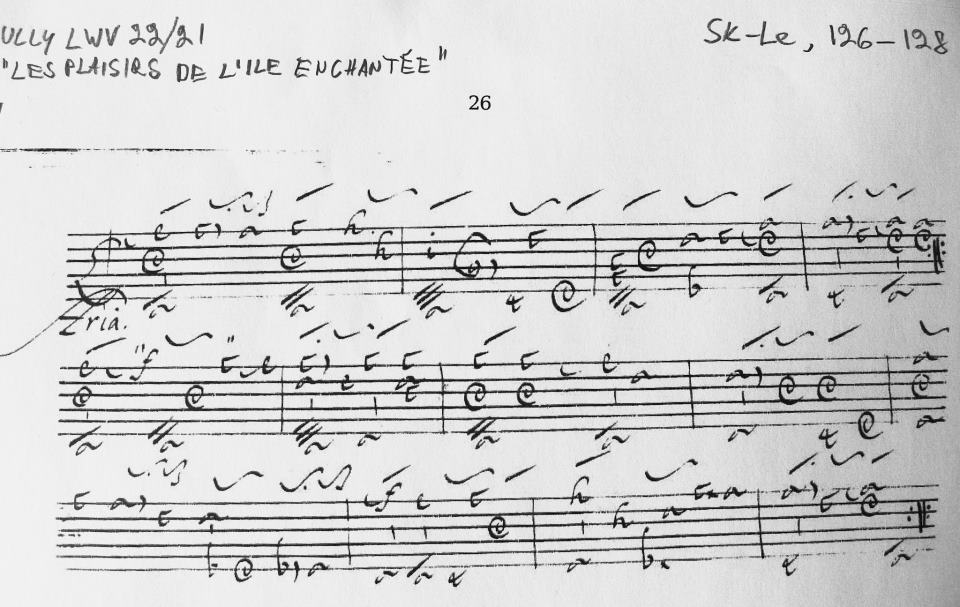
- Lully: Les Plaisirs de l'Ile enchantée (ms. Levoca).
This aria by Lully (LWV 22/21), "The Pleasures of the Enchanted Island",
is arranged by some anonymous lutenist. It comes from the manuscript
"Levoca", SK-Le ms. s.c. (library: Levoca, Evanjelicka a.v. cirkevna
kniznica), page 126. In that large manuscript - more than 160
pieces - composers of only very, very few pieces are known today:
Dufault, Losy, Bittner, Gaultier d'Angleterre, Ginter, Reusner and
Mouton. Perhaps one of these has arranged this aria?
The original tabulature (jpg).
Video in
YouTube,
video in
Vimeo
(4.5.2013)
- Lully: Rondeau ("Menuet") from "Persée" (ms. A-Wn ms. 17706).
The lute trascription of this Rondeau comes from ms. A-Wn ms. 17706, fol 6r
(Wien, Österreichische Nationalbibliothek, Musiksammlung). In the ms.
the piece is called "Menuet". The original piece by Lully is in
the "tragédie lyrique" "Persée" (Perseus), Acte IV, Scene VI (LWV 60/73).
Here is
the original lute tabulature and
the original version by Lully.
Video in
YouTube,
video in
Vimeo
(17.5.2013)
- Pieces, "Suite", in g-minor in the ms. RA-BAn Ms. 236.R-13769,
Buenos Aires, Biblioteca nacional
- Praeludium pro 2do Tono
and Allemande (ms. RA-BAn).
These Prelude and Allemande come from fol. 108v and 109r, same book spread.
The Allemande is by Pinel, the Prelude is by the the famous Anonymous.
Video in
YouTube,
video in
Vimeo
(24.5.2013)
- Pierre Gaultier: Courrante (ms. RA-BAn).
This Courante comes from fol. 109v. The composer, Pierre Gaultier,
was active nearly a century before this manuscript! He published this
piece in his printed book already in 1638, and the ms. RA-BAn is assumed
have been written around 1720. What is also interesting, is that Pierre
wrote this piece in one of the "transitional tunings", experimental
lute tunings of the early baroque. And in 1720 it was transcribed
to the "normal" baroque lute d-minor tuning! So this piece is in a way
"early music" as seen in 1720. But was it "hip", when the tuning was
changed? ;-)
Video in
YouTube,
video in
Vimeo
(25.5.2013)
- Courrante (ms. RA-BAn).
This Courante comes from fol. 110r. The composer is for the moment unknown.
In the previous page there is a Courante by Pierre Gaultier, in the next
page a Sarabande by N. de Merville. Perhaps one of these is guilty of
this strange piece? Especially the B part is quite crazy with its
rhythm shifts.
Video in
YouTube,
video in
Vimeo
(27.5.2013)
- Nicolas de Merville: Sarabande (ms. RA-BAn).
This Sarabande comes from fol. 110v-111r. The composer,
Nicolas de Merville (b c1600; d after 1643) was active nearly a century
before this manuscript, which was written around 1720! As Pierre Gaultier,
also de Merville wrote to the "transitional tunings", experimental
lute tunings of the early baroque. And probably also this piece was transcribed
to the "normal" baroque lute d-minor tuning in around 1720! So this
piece is in a way "early music" as seen in 1720.
But was it "hip", if the tuning was changed? ;-)
Video in
YouTube,
video in
Vimeo
(28.5.2013)
- Nicolas de Merville: Ciacona (ms. RA-BAn).
This Chaconne comes from fol. 111v-112r. The composer,
Nicolas de Merville (b c1600; d after 1643) was active nearly a century
before this manuscript, which was written around 1720!
Video in
YouTube,
video in
Vimeo
(31.5.2013)
- Kalivoda Suite in g-minor (ms. RA-BAn).
This "suite" is "early music" as seen in the 1720's! The pieces are on the
consecutive pages in the manuscript RA-BAn, Ms. 236.R-13769, Buenos
Aires, Biblioteca nacional, the so called "Kalivoda manuscript", which
was composed around 1720's; there is a lot of music by the late baroque
lutenists there: Weiss, Weichenberger, Pichler, ... And the author of this ms.
collected this "suite" by early to middle French baroque lute pieces!
Two of the pieces are by Merville, one piece by Pinel and Pierre
Gaultier. The composer of two pieces are not known for the moment.
Perhaps the author of RA-BAn himself composed these?
I just glued together my YouTube recordings made between 24.5.-31.5.2013.
Here is all the music as
original tabulature!
Video in
YouTube
(31.5.2013).
- German song arrangements in the ms.
D-LEm ms. II.6.24, Leipzig, Städtische Bibliotheken, Musikbibliothek
- "Die weil ich nun Kein Weib nicht habe" and Sarabande.
This anonymous song arrangement and Sarabande come from ms. D-LEm6-24,
D-LEm ms. II.6.24, Leipzig, Städtische Bibliotheken, Musikbibliothek,
fol. 124v-125r. The long name of the song, written on the ms. page, is
"Die weil ich nun Kein Weib nicht habe u. auch noch keines haben will",
so the dramatic Sarabande is very suitable to follow the song! ;-)
As it does also in the manuscript.
Video in
YouTube,
video in
Vimeo
(4.6.2013)
- "Von übermässigen Trinken und zútrinken" (ms. D-LEm6-24).
This anonymous song arrangement comes from D-LEm ms. II.6.24, Leipzig,
Städtische Bibliotheken, Musikbibliothek, fol. 91r.
Video in
YouTube,
video in
Vimeo
(7.6.2013)
- "Damons eingang zur Liebe" and
"Damons bei den baüme" (ms. D-LEm6-24).
These anonymous German Lied settings come from D-LEm ms. II.6.24, Leipzig,
Städtische Bibliotheken, Musikbibliothek, fol. 91v-92r.
Video in
YouTube,
video in
Vimeo
(10.6.2013)
- "Warum Klagstu das du dein Leben" (ms. D-LEm6-24).
This anonymous German Aria setting comes from D-LEm ms. II.6.24,
Leipzig, Städtische Bibliotheken, Musikbibliothek, fol. 234r.
Video in
YouTube,
video in
Vimeo
(11.6.2013)
- Mainly Sarabandes from the ms. RA-BAn Ms. 236.R-13769,
Buenos Aires, Biblioteca nacional
- Sarabande and Chanson (ms. RA-BAn).
This Sarabande and nameless Chanson by an anonymous composer
come from ms. RA-BAn Ms. 236.R-13769, Buenos
Aires, Biblioteca nacional, fol. 11v-12r.
Video in
YouTube,
video in
Vimeo
(15.6.2013)
- Sarabande and Double (ms. RA-BAn, f. 5v-6r).
This Sarabande with its Double by an anonymous composer
come from ms. RA-BAn Ms. 236.R-13769, Buenos
Aires, Biblioteca nacional, fol. 5v-6r.
Video in
YouTube,
video in
Vimeo
(20.6.2013)
- Sarabande and Double (ms. RA-BAn, f. 8v-9r).
Another Sarabande with its Double by an anonymous composer
in ms. RA-BAn Ms. 236.R-13769, Buenos
Aires, Biblioteca nacional, fol. 8v-9r.
Video in
YouTube,
video in
Vimeo
(1.7.2013)
- Allemande and Courante (ms. RA-BAn).
These pieces come from ms. RA-BAn Ms. 236.R-13769, Buenos Aires,
Biblioteca nacional, fol. 6v and 7v.
Video in
YouTube,
video in
Vimeo
(3.7.2013)
- Some pieces by famous composers in the manuscript
PL-Wu RM 4141 (olim Mf. 2009), Biblioteka Uniwersytecka w Warszawie,
Gabinet Zbiorów Muzycznych
- Losy: Aria in a minor (PL-Wu2009, p. 34).
This Aria with no name by Losy comes from the manuscript
PL-Wu RM 4141 (olim Mf. 2009), Biblioteka Uniwersytecka w Warszawie,
Gabinet Zbiorów Muzycznych, page 34.
Video in
YouTube,
video in
Vimeo
(12.7.2013)
- Telemann: Menuet and Trio (PL-Wu2009, p. 24).
This Menuet with its Trio by Telemann (TWV 39:2) come from the
manuscript PL-Wu RM 4141 (olim Mf. 2009), Biblioteka Uniwersytecka w Warszawie,
Gabinet Zbiorów Muzycznych, page 24.
The
original tabulature!
Video in
YouTube,
video in
Vimeo
(15.7.2013)
- Menuet in a minor (PL-Wu2009, p. 21).
This Menuet by unknown composer comes from the manuscript
PL-Wu RM 4141 (olim Mf. 2009), Biblioteka Uniwersytecka w Warszawie,
Gabinet Zbiorów Muzycznych, page 21.
Video in
YouTube,
video in
Vimeo
(18.7.2013)
- Lully: Aria (ms. PL-Wu2009, p. 17).
This Aria by Lully (LWV 31/4), perhaps set by Losy, comes from the
manuscript PL-Wu RM 4141 (olim Mf. 2009), Biblioteka Uniwersytecka w
Warszawie, Gabinet Zbiorów Muzycznych, page 17.
Video in
YouTube,
video in
Vimeo
(19.7.2013)
- Roman Turovsky-Savchuc: Sarabande, largo.
I just got the music of this beautiful neo-baroque piece by Roman, and I
play it directly from the computer screen, more or less prima vista.
Video in
YouTube
(17.8.2013)
- Pieces by "Master Leslie" from the Scottish baroque lute manuscript
"Balcarres Lute Book"
- A Scotts tune, by mr. Leslie,
Balcarres #102, p. 65.
Video in
YouTube
(22.8..2013)
- Imperial sweetnesse, by Master Leslie,
Balcarres #127, p. 81.
Video in
YouTube
(23.8.2013)
- Lully/Mr. Leslie: Belle hereuse, by Mr. Leslie (="Sommes nous pas
trop heureux"), Balcarres #129, p. 82.
Mr. Leslie seems to have known also French music!
This is an arrangement of a song by Lully: "Sommes nous pas
trop heureux" (Ballet de l'Impatience, 1661).
There is certain Scottish flavour in Mr. Leslie's arrangement, isn't there.
You can find the original Lully piece
and my theorbo version by de Visee in my
French theorbo page.
Video in YouTube.
(26.8.2013)
- My own dear honey, be kind to me, or the yellow haired ladie,
by mr. Leslie,
Balcarres #130, p. 82.
Video in
YouTube
(28.8.2013)
- The Lady Errol's delight, the 3d way, mr. Leslie's way ,
Balcarres #115, p. 76.
Video in
YouTube
(30.8.2013)
- Scottish Suite by Master Leslie of the manuscript Balcarres.
This "suite" contains all these 5 pieces by "Master Leslie" or "Mr.
Leslie" to baroque lute in the "normal" d-minor tuning, in the Scottish
baroque lute manuscript "Balcarres Lute Book". I just joined together
my previous separate videos.
I actually enjoyed very much of my humble try to understand the
Scottish soul! :-)
Here you find the written music, my own
"practical performing" facsimile.
Video in
YouTube
(30.8.2013)
- André Campra: pieces of l'Europe Galante in ms. Göttweig, Nr. 2
- Campra: Gavotte de l'Europe Galante (ms. Göttweig, Nr. 2).
This lute setting of André Campra's Gavotte comes from manuscript
Göttweig, Benediktinerstift, Musikarchiv, Lautentabulatur Nr. 2., fol. 74r.
Video in
YouTube
(6.9.2013)
- Campra: Nuit Soyes fidelle, Sarabande de l'Europe Galante.
This lute setting of André Campra's Sarabande comes from the manuscript
Göttweig, Benediktinerstift, Musikarchiv, Lautentabulatur Nr. 2.,
fol. 74v-75r.
Video in
YouTube
(9.9.2013)
- Robert de Visee in d-minor in the ms.Saizenay I
- Robert de Visee: Allemande in d-minor.
This well known(?) Allemande by de Visee comes from the ms.
Saizenay I, p. 199.
Video in
YouTube
(26.9.2013)
- Robert de Visee: Courante in d-minor.
This Courante by de Visee comes from the ms. Saizenay I, p. 200.
Video in
YouTube
(1.10.2013)
- Robert de Visee: Sarabande in d-minor.
This well known(?) Sarabande by de Visee comes from the ms. Saizenay I, p. 200.
Video in
YouTube
(4.10.2013)
- Robert de Visee: Gigue grave in d-minor.
This Sarabande by de Visee comes from the ms. Saizenay I, p. 201.
Video in
YouTube
(10.10.2013)
- Robert de Visee: Suite in d-minor.
The above four pieces glued together. It is perhaps proper to call
this "suite", because the pieces are on consecutive pages in
the ms. Saizenay I (p. 199-201).
Video in
YouTube
(11.10.2013)
- ???
- Just for fun.
First baroque lute, then theorbo.
Video in
YouTube
(24.10.2013)
- Just for fun #2.
Renaissance lute.
Video in
YouTube
(1.11.2013)
- Weiss in Rostock ms. Mus. Saec. XVII.18.53.1A:
- Weiss: Prelude in d-minor (ms. Rostock).
This Prelude by Silvius Leopold Weiss comes from the manuscript
D-ROu ms. Mus. Saec. XVII.18.53.1A, Rostock, University Library
(D-ROu53-1A), fol. 18v-19r.
Video in
YouTube
(6.11.2013)
- Weiss: Allemande in d-minor (ms. Rostock).
This Allemande by Silvius Leopold Weiss comes from the manuscript
D-ROu ms. Mus. Saec. XVII.18.53.1A, Rostock, University Library
(D-ROu53-1A), fol. 19av-19br.
Video in
YouTube
(9.11.2013)
- Weiss: Courente in d-minor (ms. Rostock).
This Courante by Silvius Leopold Weiss comes from the manuscript
D-ROu ms. Mus. Saec. XVII.18.53.1A, Rostock, University Library
(D-ROu53-1A), fol. 19bv-20r.
Video in
YouTube
(14.11.2013)
- Weiss: Sarabande and Passepied in d-minor (ms. Rostock).
The Sarabande and Passepied by Silvius Leopold Weiss come from the manuscript
D-ROu ms. Mus. Saec. XVII.18.53.1A, Rostock, University Library
(D-ROu53-1A), fol. 20v and 21v.
Video in
YouTube
(15.11.2013)
- Weiss: Suite in d-minor (ms. Rostock).
Prelude - Allemande - Courante - Sarabande - Passepied.
This "Suite" is actually just a selection of pieces in d-minor by
Silvius Leopold Weiss in the manuscript D-ROu ms. Mus. Saec. XVII.18.53.1A,
Rostock, University Library (D-ROu53-1A). The pieces are glued together by
using my separate "YouTubings" above.
Video in
YouTube
(15.11.2013)
- Weiss: Prelude in C-Major (WeissSW 86.1, ms. Rostock).
This Prelude by Silvius Leopold Weiss comes from the manusctipt
D-ROu ms. Mus. Saec. XVII.18.53.1A, Rostock, University Library
(D-ROu53-1A), fol. 8v-9r.
Video in
YouTube
(10.12.2013)
- Pieces in the ms. "Virginia Renata von Gehema":
- "Allmanda" (ms. "Virginia Renata von Gehema", Berlin 40264).
This Allemande by anonymous composer comes from the manuscript of
"Virginia Renata von Gehema", fol. 75v, Berlin Mus. Ms. 40264)
(D-B40264/145). The first two measures had to be reconstructed.
Video in
YouTube
(19.12.2013)
- "Couranta" (ms. "Virginia Renata von Gehema", Berlin 40264).
This Courante by anonymous composer comes from the manuscript of
"Virginia Renata von Gehema", fol. 76r, Berlin Mus. Ms. 40264)
(D-B40264/146).
Video in
YouTube
(22.12.2013)
- Dufault: "Sarabanda" (ms. "Virginia Renata von Gehema", Berlin 40264).
This Sarabande by F. Dufault comes from the manuscript of
"Virginia Renata von Gehema", fol. 76v, Berlin Mus. Ms. 40264)
(D-B40264/147).
Video in
YouTube
(23.12.2013)
- Dufault(?): 3 pieces in d-minor (ms. "Virginia Renata von Gehema",
Berlin 40264).
Allemande-Courante-Sarabande, fol. 75v-76v in the manuscript of
"Virginia Renata von Gehema", Berlin Mus. Ms. 40264) (D-B40264/145-147).
These pieces are on consecutive pages of the ms. Only the Sarabande
is known to be by F. Dufault, but it is possible that also the other
two are by him. I just glued together those 3 recordings above.
Video in
YouTube
(23.12.2013).
- Lully in the ms. A-Wn ms. 17706:
- Lully: "C'est l'amour qui nous menace" (LWV 65/13).
This Gavotte setting of an aria in Lully's "Roland" is probably made by
Gallot le Jeune. It is written in the ms. A-Wn ms. 17706,
Österreichische Nationalbibliothek, Musiksammlung, fol. 4v.
Video in
YouTube
(28.12.2013).
- Lully: "L'hymen seul ne saurait plaire" (LWV 53/76).
This Menuet setting of an aria in Lully's "Atys" is made by some unknown
lutenist. It is written in the ms. A-Wn ms. 17706,
Österreichische Nationalbibliothek, Musiksammlung, fol. 16v.
Don't blame me or Lully for the text, blame the librettist
Philippe Quinault. ;-)
Video in
YouTube
(29.12.2013).
- Lully: "La beauté la plus severe (LWV 53/75).
This lute setting of this aria in Lully's "Atys" is made by some unknown
lutenist. It is written in the ms. A-Wn ms. 17706,
Österreichische Nationalbibliothek, Musiksammlung, fol. 16v-17r.
Video in
YouTube
(31.12.2013).
- Pieces in the ms. PL-Kj ms. mus. 40620 (olim: Berlin):
- Hinterleitner: Sarabande (PL-Kj40620/103v).
The third bar of this Sarabande, written about 1700, clearly says
"All my troubles seem so..." So perhaps Paul McCartney knew the
baroque lute music? ;-)
The manuscript is PL-Kj ms. mus. 40620 (olim: Berlin), fol. 103v-104r,
Kraków, Biblioteka Jagiellonska.
Video in
YouTube
(3.1.2014).
- Lully/Losy: Aria (LWV 31/4) (PL-Kj40620/15r).
This Aria by Lully (LWV 31/4) comes from the manuscript PL-Kj ms.
mus. 40620 (olim: Berlin), fol. 15r, Kraków, Biblioteka Jagiellonska.
It is probably set to lute by the noble lutenist Johann Anton Losy von
Losinthal, also known as Comte d'Logy.
Video in
YouTube
(8.1.2014).
- Menuet in G-major (PL-Kj40620/33v).
This little Menuet by unknown composer comes from the manuscript PL-Kj ms.
mus. 40620 (olim: Berlin), fol. 33v, Kraków, Biblioteka Jagiellonska.
Video in
YouTube
(14.1.2014).
- Ciaccona in G-major (PL-Kj40620/34r-35r).
This Ciaccona (Chaconne) by unknown composer comes from the
manuscript PL-Kj ms. mus. 40620 (olim: Berlin), fol. 34r-35r,
Kraków, Biblioteka Jagiellonska.
Video in
YouTube
(19.1.2014).
- More pieces in the ms. PL-Kj ms. mus. 40620 (olim: Berlin):
- Sarabande in a-minor (PL-Kj40620/15v).
This Sarabande by unknown composer comes from the
manuscript PL-Kj ms. mus. 40620 (olim: Berlin), fol. 15v-16r,
Kraków, Biblioteka Jagiellonska.
Video in
YouTube
(1.2.2014).
- Minuett in a-minor (PL-Kj40620/17r).
This Menuet - "C'est la favorite du Roy" - comes from the
manuscript PL-Kj ms. mus. 40620 (olim: Berlin), fol. 17r-17v,
Kraków, Biblioteka Jagiellonska.
Video in
YouTube
(4.2.2014).
- Aria in a-minor (PL-Kj40620/17v).
This anonymous Aria by an anonymous composer comes from the
manuscript PL-Kj ms. mus. 40620 (olim: Berlin), fol. 17v-18r,
Kraków, Biblioteka Jagiellonska.
Video in
YouTube
(6.2.2014).
- Strobel: Courante in a-minor (PL-Kj40620/18v).
This Courante by Valentin Strobel comes from the
manuscript PL-Kj ms. mus. 40620 (olim: Berlin), fol. 18v-19r,
Kraków, Biblioteka Jagiellonska.
Video in
YouTube
(10.2.2014).
- Passagaglia (PL-Kj40620/93v).
This Passagaglia by an anonymous composer comes from the
manuscript PL-Kj ms. mus. 40620 (olim: Berlin), fol. 93v-95r,
Kraków, Biblioteka Jagiellonska.
Video in
YouTube
(21.2.2014).
[Just in case someone wishes to try her/his hand on this
funny/crazy/fun/interesting piece, here is my
"
practical performance facsimile" –
I just cleared some letters, added some rhythm and ornament expressions, etc.]
- More pieces from the Scottish baroque lute manuscript
"Balcarres Lute Book"
- The Lady Errol's delight, the 1st way, mr. John Red's way (ms. Balcarres).
This piece comes from the Scottish baroque lute manuscript
"Balcarres Lute Book", #114, p. 75.
Video in
YouTube
(11.3.2014).
- The prince's air, the 9th lowed halfe a note,
mr. Beck's way (ms. Balcarres).
This piece comes from the Scottish baroque lute manuscript
"Balcarres Lute Book", #15, p. 11.
Video in
YouTube
(15.3.2014).
- The lass, which made the bed to me, by John Red (ms. Balcarres).
This piece comes from the Scottish baroque lute manuscript
"Balcarres Lute Book", #77, p. 43.
Video in
YouTube
(25.3.2014).
- The Lady Binnies lilt, by David Grieve.
This piece comes from the Scottish baroque lute manuscript
"Balcarres Lute Book", #100, p. 63.
Video in
YouTube
(29.3.2014).
- Niin kauan minä tramppaan (Finnish folk song).
This is my own simple and archaic version of a Finnish folk
song - South Ostrobothnia district. The text of the song is actually
very macho...;-)
The tabulature
of my version.
Video in
YouTube
(9.4.2014).
- Anonymous pieces in the manuscript "Podebrady Jelinik"
- Allemande (ms. Podebrady Jelinik).
This anonymous "Allam:" comes from the Czech manuscript "Podebrady
Jelinik" (CZ-PnmE36), p. 48-49.
Video in
YouTube
(30.5.2014).
- Courante (ms. Podebrady Jelinik).
This anonymous "Couran:" comes from the Czech manuscript "Podebrady
Jelinik" (CZ-PnmE36), p. 50-51.
Video in
YouTube
(31.5.2014).
- Aria (ms. Podebrady Jelinik).
This anonymous "Aria" comes from the Czech manuscript "Podebrady
Jelinik" (CZ-PnmE36), p. 51.
Video in
YouTube
(2.6.2014).
- "Svejk Sonata" (ms. Podebrady Jelinik).
This "Sonata" is just 3 pieces on consecutive pages in the Czech
manuscript "Podebrady Jelinik" (CZ-PnmE36), p. 48-51.
The only connection to the "Svejk" by J. Hasek is that I just
finished the great book and wanted to play some Czech baroque
music. ;-)
The three pieces are just the Allemande, Courante and Aria above,
glued together.
Here is the original tabulature.
Video in
YouTube
(2.6.2014).
- Cierwenka (Cervenka) in the manuscript "Podebrady Jelinik"
- Cierwenka: Allamanda (ms. Podebrady Jelinik).
This "Allamanda" is the first part of a Partita by Cierwenka (Cervenka).
It comes from the Czech manuscript "Podebrady Jelinik"
(CZ-PnmE36), p. 135-137.
Video in
YouTube
(10.6.2014).
- Cierwenka: Saraband (ms. Podebrady Jelinik).
This "Saraband" is the second part of a Partita by Cierwenka (Cervenka).
It comes from the Czech manuscript "Podebrady Jelinik"
(CZ-PnmE36), p. 137-138.
Video in
YouTube
(12.6.2014)
- Cierwenka: Bourree (ms. Podebrady Jelinik).
This "Bouree" is the third part of a Partita by Cierwenka (Cervenka).
It comes from the Czech manuscript "Podebrady Jelinik"
(CZ-PnmE36), p. 138-139.
Video in
YouTube
(13.6.2014)
- Cierwenka: Menuet (ms. Podebrady Jelinik).
This "Menuet" is the fourth and last part of a Partita
by Cierwenka (Cervenka).
It comes from the Czech manuscript "Podebrady Jelinik"
(CZ-PnmE36), p. 140.
Video in
YouTube
(13.6.2014)
- Cierwenka: Partita in C-major (ms. Podebrady Jelinik).
Allamanda-Saraband-Bouree-Menuet. This Partita by very obscure
Bohemian composer Cierwenka (Cervenka) is written in the Czech
manuscript "Podebrady Jelinik" (CZ-PnmE36), p. 135-140.
The four parts were recorded separately - see above - and glued together.
Here is the original tabulature,
which I actually have tried to make more readable...
Video in
YouTube
(13.6.2014)
- Anonymous partita in the ms. PL-Wu RM 4142 (olim Mf. 2010)
- Allemande W.B. 2do, La Plainte du Comte de Tallard (ms. PL-Wu2010).
This Allemande "La Plainte du Comte de Tallard" is possibly by St-Luc.
It comes from the Polish ms. PL-Wu RM 4142 (olim Mf. 2010), p. 72.
Video in
YouTube
(30.6.2014)
- Courente W.B. 2do (ms. PL-Wu2010).
This Courante comes from the Polish ms. PL-Wu RM 4142 (olim Mf. 2010), p. 74.
The composer is unknown.
Video in
YouTube
(7.7.2014)
- Sarabande W.B. 2do (ms. PL-Wu2010).
This Sarabande comes from the Polish ms. PL-Wu RM 4142 (olim Mf. 2010), p. 75.
The composer is unknown.
Video in
YouTube
(15.7.2014)
- Menuet W.B. 2do (ms. PL-Wu2010).
This Menuet comes from the Polish ms. PL-Wu RM 4142 (olim Mf. 2010), p. 75.
The composer is unknown.
Video in
YouTube
(16.7.2014)
- Partita in a-minor, W.B. 2do (ms. PL-Wu2010).
Allemande-Courente-Sarabande-Menuet. These pieces come from the Polish
ms. PL-Wu RM 4142 (olim Mf. 2010), p.72-75.
The four parts were recorded separately - see above - and glued together.
Here is the original tabulature.
Video in
YouTube
(17.7.2014)
- Eear worms after very intensive early music course...
- Monteverdi: First Sinfonia of "Ulysses".
After a very intensive early music course I had to continue with
one of the many ear worms we got there. So I arranged the tiny first
Sinfonia of Monteverdi's opera "Il ritorno d'Ulisse in patria" to d-minor
baroque lute, which probably was never used in Monteverdi's music...;-)
Video in
YouTube
(28.7.2014)
- Händel: Alla Hornpipe (Water Music HWV 349).
After a very intensive early music course I had to continue with
another of the many ear worms we got there. So I arranged this Hornpipe
by Händel to d-minor baroque lute.
Video in
YouTube
(???.2014)
- Pieces in a-minor, D-LEm ms. II.6.24,
Leipzig, Städtische Bibliotheken, Musikbibliothek
- Courante (ms. D-LEm6-24, 125v).
This anonymous Courante comes from D-LEm ms. II.6.24,
Leipzig, Städtische Bibliotheken, Musikbibliothek, fol. 125v-126r.
Video in
YouTube
(26.8.2014)
- Grand Ballet (ms. D-LEm6-24, 126r).
This anonymous Ballet comes from D-LEm ms. II.6.24,
Leipzig, Städtische Bibliotheken, Musikbibliothek, fol. 126r.
Video in
YouTube
(27.8.2014)
- Chanson (ms. D-LEm6-24, 126v).
This anonymous Chanson comes from D-LEm ms. II.6.24,
Leipzig, Städtische Bibliotheken, Musikbibliothek, fol. 126rv
Video in
YouTube
(29.8.2014)
- Sarabande (ms. D-LEm6-24, 127r).
This anonymous (and strange!) Sarabande comes from D-LEm ms. II.6.24,
Leipzig, Städtische Bibliotheken, Musikbibliothek,
fol. 127r.
Video in
YouTube
(30.8.2014)
- "Suite" in a-minor (ms. D-LEm6-24, 125v-127r).
Courante – Grand Ballet – Chanson – Sarabande.
The source of these
anonymous pieces on the consecutive pages (fol. 125v-127r) is
D-LEm ms. II.6.24, Leipzig, Städtische Bibliotheken, Musikbibliothek.
The four pieces were recorded separately – see above –
and just glued together.
Video in
YouTube
(30.8.2014)
- D-LEm ms. II.6.24,
Leipzig, Städtische Bibliotheken, Musikbibliothek
- Passaggio (ms. D-LEm6-24, 6v).
This anonymous, "non mesuré" Passaggio comes from D-LEm ms. II.6.24,
Leipzig, Städtische Bibliotheken, Musikbibliothek,
fol. 6v-7r. The term "non mesuré" means that there are no bar lines
and no note values – player has to improvise them.
Video in
YouTube
(5.9.2014)
- Allemande (ms. D-LEm6-24, 11v).
This anonymous Allemande comes from D-LEm ms. II.6.24,
Leipzig, Städtische Bibliotheken, Musikbibliothek, fol. 11v-12r.
Video in
YouTube
(12.9.2014)
- Courante (ms. D-LEm6-24, 12v).
This anonymous, untypical Courante comes from D-LEm ms. II.6.24,
Leipzig, Städtische Bibliotheken, Musikbibliothek, fol. 12v-13r.
Video in
YouTube
(3.10.2014)
- Sarabande et Double (ms. D-LEm6-24, 10v).
This anonymous Sarabande with its Double comes from D-LEm ms. II.6.24,
Leipzig, Städtische Bibliotheken, Musikbibliothek,
fol. 10v-11r.
Video in
YouTube
(10.10.2014)
- Amarillis je renonce à vos charmes (CH-A).
This recently discovered single sheet with a lute version of the air
"Amarillis je renonce à vos charmes" comes from Aargauer
Kantonsbibliothek, Aarau, Zurlaubiana AH 70/157.
Thanks to Andreas Schlegel for sending to the Lutelist the the link
to this interesting facsimile page:
http://www.accordsnouveaux.ch/de/DownloadD/files/CH-A_AH_70-157_20140921.pdf.
Video in
YouTube
(23.9.2014)
- Something very different: short teenage memory ... ;-).
Guess what this is! ;-)
Video in
YouTube
(23.10.2014)
- PL-Kj ms. mus. 40625 (olim: Berlin),
Kraków, Biblioteka Jagiellonska, fol. 1v-2r
- Allemande in e minor (PL-Kj40625).
This anonymous "Allam:" comes from PL-Kj ms. mus. 40625 (olim: Berlin),
Kraków, Biblioteka Jagiellonska, fol. 1v-2r.
Video in
YouTube
(24.11.2014)
- Courante in e minor (PL-Kj40625).
This anonymous "Courente" comes from PL-Kj ms. mus. 40625 (olim: Berlin),
Kraków, Biblioteka Jagiellonska, fol. 2v-3r.
Video in
YouTube
(5.12.2014)
- Sarabande in e minor (PL-Kj40625).
This anonymous "Sarabanda" comes from PL-Kj ms. mus. 40625 (olim: Berlin),
Kraków, Biblioteka Jagiellonska,
fol. 3v.
Video in
YouTube
(7.12.2014)
- Menuet in e minor (PL-Kj40625).
This anonymous "Minuett" comes from PL-Kj ms. mus. 40625 (olim: Berlin),
Kraków, Biblioteka Jagiellonska,
fol. 3v-4r.
Video in
YouTube
(17.12.2014)
- ...
- Losy: Prelude and Aria (aka "Caro mio ben") (ms. PL-Kj40260).
These Prelude and Aria come from PL-Kj ms. mus. 40620 (olim: Berlin),
fol. 4r-5r.
The Aria reminds very much the famous song "Caro mio ben", which is
said to be composed by Giordiano (1748-1798). Well, this manuscript was
written years before Giordiano's times... Versions of this piece are
found also in several other mss. of the period. The arrangement
is possibly by Losy.
Video in
YouTube
(4.2.2015)
- J.S. Bach: Sarabande BWV995.
My own arrangement to baroque lute of this famous Sarabande by
JSB.
Video in
YouTube
(19.3.2015)
- J.S. Bach: Ritornello "Ruht wohl".
This is my lute arrangement of the instrumental "ritornelli"
in the final chorus of St. John Passion.
Video in
YouTube
(5.4.2015)
- ...
- Lully/Gallot: Aria "C'est l'amour qui nous menace".
This Aria by Gallot "le jeune" comes from ms. A-KR L77
(Benediktiner-Stift Kremsmunster, Regenterei oder Musikarchiv).
It is an instrumental arrangement of Lully's aria
"C'est l'amour qui nous menace", in opera
(tragedie en musique) "Roland".
Video in
YouTube
(9.6.2015)
- Gaultier: L' adieu de Mlle Le brun Cour..
This courante by Denis Gaultier comes from the "Barbe" ms.
(F-Pn Rés. Vmb. ms. 7), p. 102. Who was this Mademoiselle Le Brun?
And why and what kind of l'adieu Denis means? Who knows?
Video in
YouTube
(28.8.2015)
- ...
- ...
See also my pages
French theorbo music
/
Archlute music
/
10-course
lute music
/
Chitarrone
music
/
Chitarrino
music.
There are also some other arrangements, intabulations, etc. in my
Contributions page.

by WebCounter
(14.1.2010)